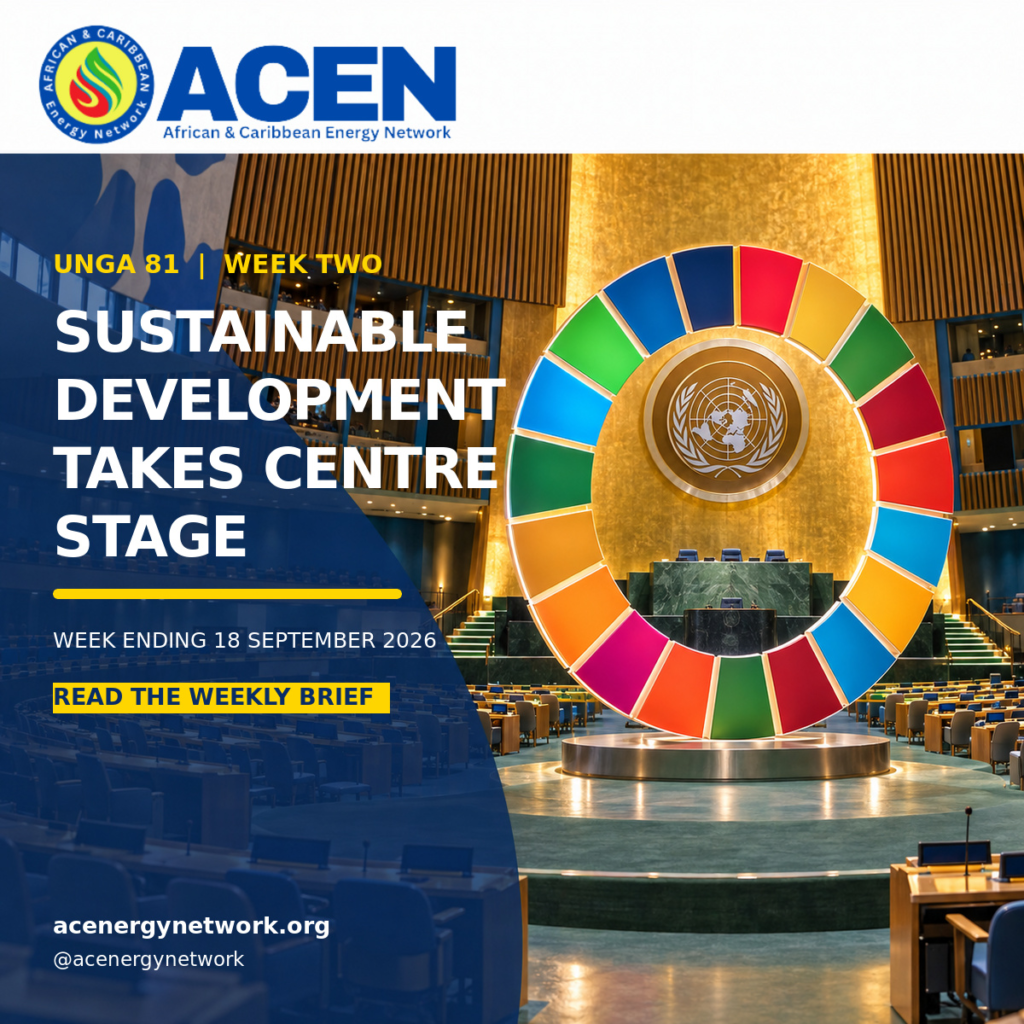
As the second week of the 81st United Nations General Assembly concludes, attention is shifting from organizational preparations to high-level global action on sustainable development, gender equality, climate change, energy access, and international cooperation.
The second week of the 81st Session of the United Nations General Assembly concluded on September 18, 2026, with sustainable development emerging as its defining focus.
This was largely a bridge week between the formal opening of UNGA 81 on September 8 and the arrival of presidents, prime ministers and other world leaders for the General Debate beginning September 22.
While the General Assembly did not produce a major new political declaration this week, several important events and reports helped establish the evidence, priorities and expectations that will guide the approaching High-Level Week.
The Goals Lounge opened at UN Headquarters
The UNGA 81 Goals Lounge opened on September 14 and will continue through September 25.
Convened by the United Nations Deputy Secretary-General and hosted by the UN Office for Partnerships, the Goals Lounge brings together governments, businesses, civil society organizations, innovators, and development partners to examine practical ways to accelerate the Sustainable Development Goals.
Its discussions are intended to move beyond broad commitments by identifying partnerships, investments and initiatives capable of delivering measurable results.
Previous editions of the Goals Lounge have supported announcements and financial commitments in areas including women’s leadership, mental health and digital transformation.
During UNGA 81, the platform will also explore how development priorities can be converted into investable projects and how public-private partnerships can support economic transformation.
Information about the programme is available through the UNGA 81 Goals Lounge.
New evidence reveals continuing setbacks for women’s leadership
On September 17, UN Women and the United Nations Department of Economic and Social Affairs launched Progress on the Sustainable Development Goals: The Gender Snapshot 2026.
The annual report examines gender equality across all 17 Sustainable Development Goals. This year’s findings concentrate particularly on women’s representation in leadership and decision-making.
The report warns that the promise of equal leadership remains far from being realized.
At the current pace of progress, gender parity in national parliaments will not be achieved for another 63 years. Of the 175 chief justices represented in the report’s data, 144 are men and only 31 are women.
The report also found signs that national institutions responsible for advancing gender equality are being weakened. In a 2026 survey of national gender-equality mechanisms, 32 per cent reported an erosion of their institutional power during the previous two years.
This weakening affects the availability of funding, accountability for gender-responsive policies and the implementation of commitments already made by governments.
The report nevertheless reinforces an important conclusion: when women are included in leadership and decision-making, institutions are more responsive, and progress is strengthened across education, environmental protection, poverty reduction and other Sustainable Development Goals.
The findings are available through the United Nations Gender Snapshot 2026 portal.
The 2026 SDG Moment launches the decisive push toward 2030
The week concluded on September 18 with the annual Sustainable Development Goals Moment in the United Nations General Assembly Hall.
Convened by Secretary-General António Guterres under the theme “Together, We Can Get There,” the SDG Moment brought governments, civil society, businesses, young people, and development leaders together to examine how to accelerate progress in the remaining years of the 2030 Agenda.
The latest United Nations assessment shows that only 36 per cent of the 139 SDG targets for which trend data are available are currently on track or demonstrating moderate progress.
Although this represents some improvement, progress remains far too slow and uneven.
Debt distress, insufficient financing, armed conflict, inequality and climate-related shocks continue to prevent many developing countries from investing adequately in healthcare, education, energy, infrastructure and social protection.
The SDG Moment highlighted the need to scale proven solutions, increase investment, strengthen partnerships and address structural barriers that continue to delay progress.
It also featured national experiences, community-led initiatives and discussions on the opportunities and risks associated with artificial intelligence.
Rather than presenting the 2030 Agenda as beyond reach, the event emphasized that meaningful progress remains possible if international cooperation is supported by financing, accountability and sustained political action.
More information is available on the official 2026 SDG Moment page.
High-Level Week preparations intensified
This week, the United Nations also finalized preparations for one of the largest annual gatherings in global diplomacy.
High-Level Week officially begins on September 18, while the General Debate will take place from September 22 through September 28.
Leaders representing the United Nations’ 193 Member States are expected to address armed conflict, international security, economic instability, climate change, sustainable development, artificial intelligence, global health and the future of multilateral cooperation.
The gathering is taking place amid declining confidence in international institutions, serious financial pressure across the UN system and continuing demands for reform of the Security Council and the international financial architecture.
The selection of the next United Nations Secretary-General will also form an important backdrop to this year’s meetings as António Guterres approaches the conclusion of his term on December 31, 2026.
Why this week matters for Africa and the Caribbean
The discussions and evidence released this week are especially important for African and Caribbean countries.
These regions continue to face interconnected challenges involving debt, climate vulnerability, access to development financing, gender inequality, infrastructure gaps and energy poverty.
The emphasis on partnerships and investment must therefore be translated into financing that reaches communities—not simply additional declarations.
The Gender Snapshot also reinforces the importance of ensuring that women are fully represented in energy policy, climate planning, infrastructure development and investment decisions.
Women are frequently among those most affected by energy poverty. They must also be recognized as leaders, entrepreneurs, engineers, policymakers and investors capable of designing and delivering energy solutions.
What ACEN will be watching next
The African & Caribbean Energy Network will closely follow several events during the coming High-Level Week.
On September 22, the Global Investors for Sustainable Development Alliance, the Government of Kenya and UN partners will convene an investment roundtable focused on mobilizing private capital for Kenya’s national development priorities. These priorities include Mission 300, Kenya’s Energy Compact and infrastructure investment.
On September 23, the High-Level Event on Climate Action and the Just Transition will bring together developed and developing countries, major economies, vulnerable nations and energy-producing and energy-consuming countries.
The meeting is expected to examine how governments can accelerate the energy transition, strengthen energy security, advance climate justice and protect people from the worsening effects of climate change.
On September 24, the annual SDG 7 Action Forum will focus specifically on access to affordable, reliable, sustainable and modern energy for all.
That same day, the United Nations will convene a High-Level Meeting on Sea-Level Rise—an issue of critical importance to Small Island Developing States and low-lying coastal communities across the Caribbean and Africa.
The full programme is available through the United Nations High-Level Week portal.
From global commitments to community-level results
The second week of UNGA 81 reinforced a simple but urgent message: progress is possible, but the present pace of action is insufficient.
Reports and high-level meetings provide valuable evidence and political direction. Their real value, however, will be measured by whether they produce stronger institutions, inclusive leadership, accessible financing and practical improvements in people’s lives.
For ACEN, that includes ensuring that ending energy poverty remains central to the global development agenda.
Affordable and reliable energy supports healthcare, education, food security, digital access, entrepreneurship, employment and community resilience. Progress on SDG 7 therefore strengthens progress across the entire 2030 Agenda.
As world leaders gather for the General Debate, ACEN will continue advocating for an energy transition that is inclusive, adequately financed and responsive to the realities of communities across Africa, the Caribbean and the wider Global South.
Published by the African & Caribbean Energy Network
Ending Energy Poverty. Advancing SDG 7.
acenergynetwork.org