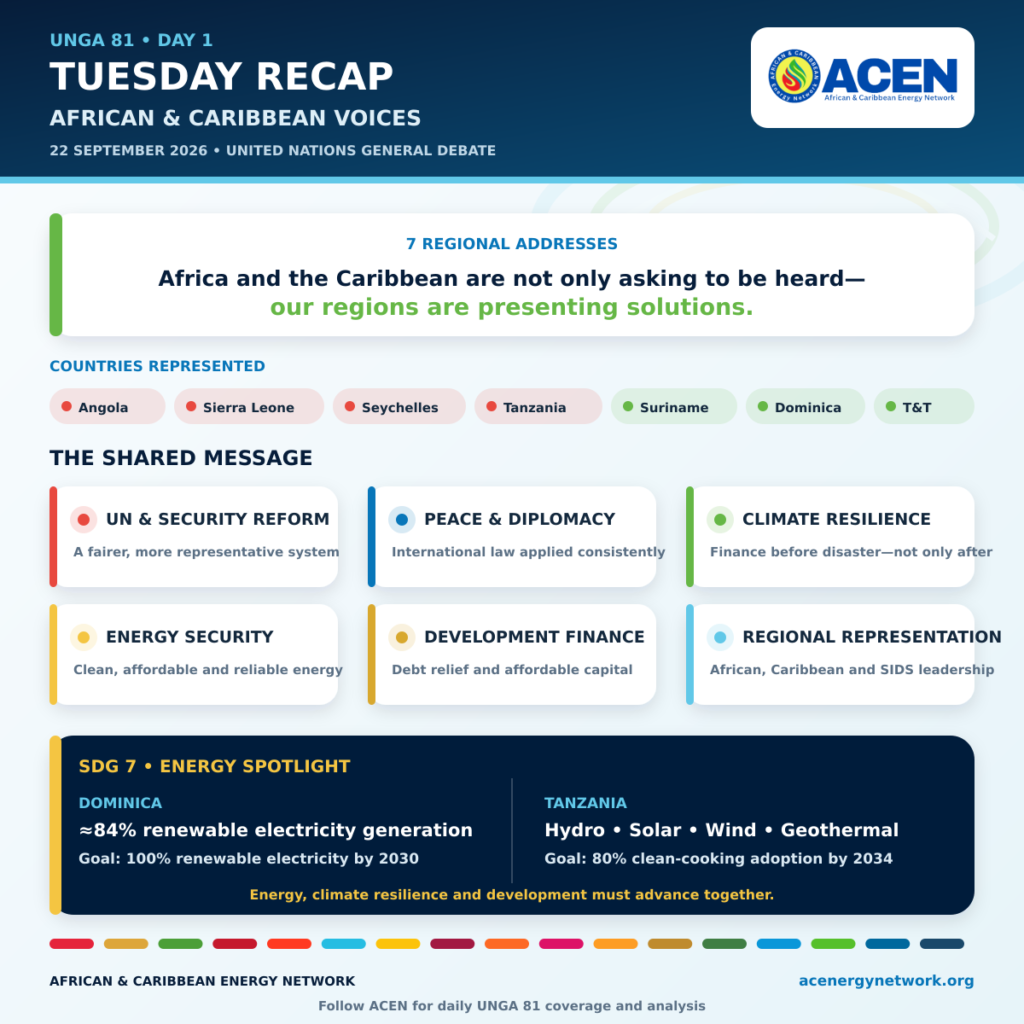
The opening day of the 81st United Nations General Assembly brought important perspectives from Angola, Sierra Leone, Seychelles, Tanzania, Suriname, Dominica, and Trinidad and Tobago.
While each country addressed its own priorities, several shared messages emerged: the need for a more representative United Nations, fairer development financing, stronger climate action, energy and food security, peace through diplomacy, and greater recognition of the vulnerabilities facing Africa, the Caribbean and Small Island Developing States.
🇦🇴 Angola
President João Lourenço emphasized diplomacy, African-led conflict resolution and respect for international law. He called for Africa, Latin America and Asia to receive permanent representation on the UN Security Council and urged reforms to the international financial system. He also highlighted affordable climate finance, debt relief, technology transfer and bridging the digital divide.
🇸🇷 Suriname
President Jennifer Geerlings-Simons addressed the impact of conflict on global food and energy prices, the situations in Haiti and Cuba, restorative justice for slavery and colonialism, and the need for dedicated representation for small island and low-lying coastal states. She called for climate financing that rewards countries such as Suriname for protecting their forests. She also outlined plans to use future oil and gas revenues to diversify the economy while incorporating renewable energy into the country’s energy mix.
🇸🇱 Sierra Leone
President Julius Maada Bio drew on Sierra Leone’s own experience of civil war, recovery and UN-supported peacebuilding. He called for consistent application of international law, greater investment in conflict prevention and development, reform of the global financial architecture and permanent African representation on the Security Council. He also advanced the case for reparatory justice and fairer value for Africa’s natural resources.
🇩🇲 Dominica
President Sylvanie Burton delivered one of Tuesday’s strongest messages on climate resilience and clean energy. She argued that resilience must be financed before disaster strikes—not only after communities have been devastated.
Dominica’s geothermal power plant is now operating commercially, helping raise renewable energy to approximately 84% of the country’s electricity generation. The country is working toward 100% renewable electricity by 2030. President Burton described clean energy as more than an environmental project: it is a foundation for energy security, economic transformation, investment and employment.
🇸🇨 Seychelles
President Mathew Antonio Patrick Herminie called for renewed multilateralism, maritime security, protection of ocean resources and stronger action against illegal fishing and transnational crime. He reaffirmed Africa’s demand for permanent Security Council representation and urged accessible long-term financing, debt relief and full use of the Multidimensional Vulnerability Index when evaluating Small Island Developing States.
🇹🇿 Tanzania
Vice President Deogratius Ndejembi highlighted Tanzania’s investments in hydropower, solar, wind and geothermal energy. He also presented the country’s clean-cooking strategy, which aims for 80% household adoption by 2034. Tanzania called for climate financing through grants and concessional funding, stronger representation for developing countries in global financial decisions, and urgent implementation of the Sustainable Development Goals.
🇹🇹 Trinidad and Tobago
Prime Minister Kamla Persad-Bissessar focused on organized crime, illicit firearms, narcotics trafficking, regional security and Haiti. As Trinidad and Tobago prepares to serve on the Security Council for 2027–2028, she pledged to bring the perspective of a Caribbean Small Island Developing State to global peace and security discussions. She also emphasized the need for developing countries to help shape global rules governing emerging technologies and energy transformation.
The central message from Tuesday was unmistakable: Africa and the Caribbean are not asking merely to be included in global discussions. Our countries are presenting solutions, demonstrating leadership and demanding a fair role in shaping the systems that determine our future.
For the African & Caribbean Energy Network, the addresses from Dominica, Tanzania and Suriname were particularly significant. They reinforced that energy security, climate resilience, affordable financing and sustainable development must advance together.
We will continue following the African and Caribbean voices at UNGA 81 throughout the week.
🔗 Follow ACEN for daily coverage and analysis: