African & Caribbean Voices Demand Fair Technology, Climate Justice and Global Reform
Saturday kept the momentum going! 🔥
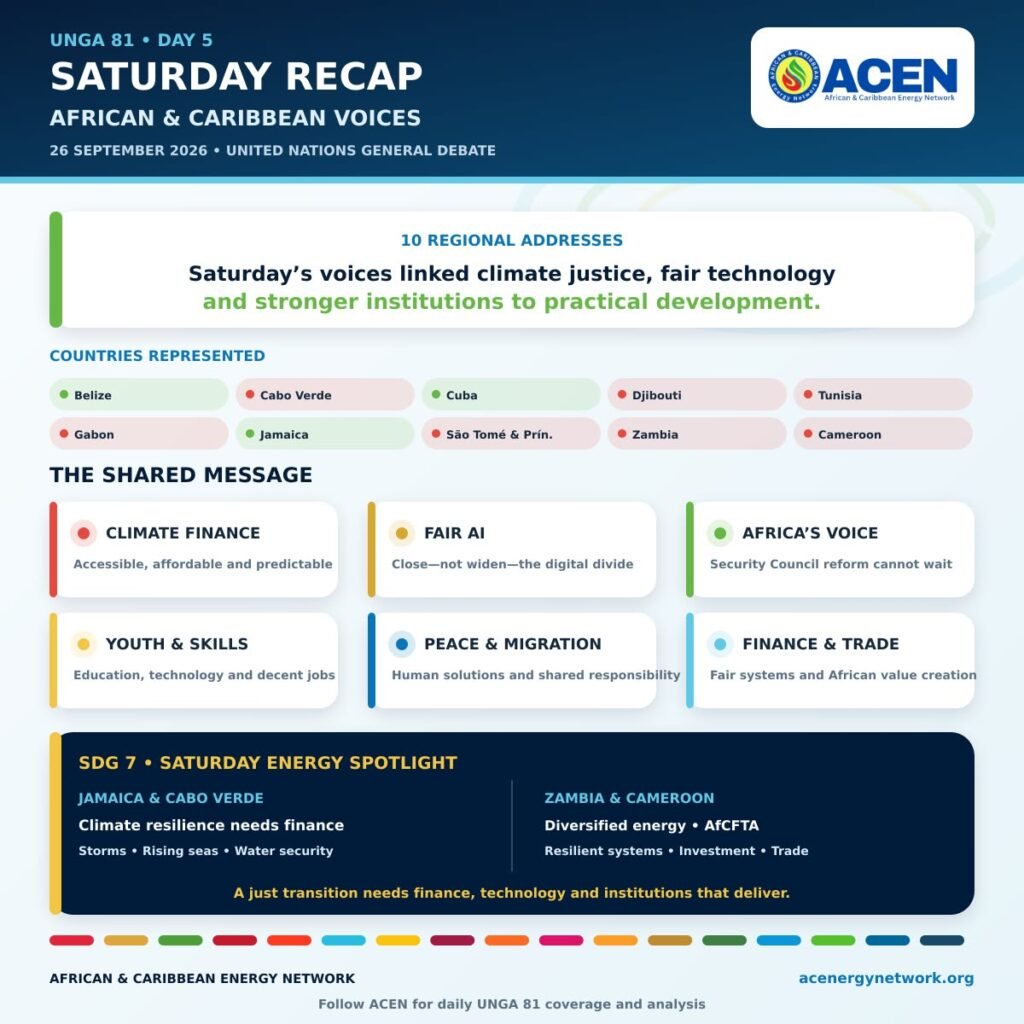
Ten African and Caribbean countries addressed the United Nations General Assembly, connecting climate justice, responsible artificial intelligence, migration, youth development, peace and international reform.
🇧🇿 BELIZE
Prime Minister John Briceño warned that poorly governed artificial intelligence could deepen inequality, displace workers and leave developing countries dependent on technologies designed elsewhere. He also addressed rising seas, debt, reparatory justice, Haiti and the need for a fairer post-2030 development framework.
🇨🇻 CABO VERDE
Prime Minister Francisco Avelino Vieira de Carvalho reaffirmed his country’s faith in international law, dialogue and peaceful conflict resolution. He said climate change is already affecting Cabo Verde through drought, water scarcity, ocean acidification and rising seas, while calling for fair African representation on the Security Council.
🇨🇺 CUBA
Foreign Minister Bruno Rodríguez Parrilla condemned the United States blockade and what he described as continuing economic warfare against the Cuban people. He defended regional sovereignty and warned that international relations must not be governed by force or the “law of the jungle.”
🇩🇯 DJIBOUTI
Foreign Minister Abdoulkader Houssein Omar highlighted the humanitarian pressures created by people fleeing the conflict in Yemen. He called for international assistance, protection of Red Sea navigation and peaceful, African-centred solutions in Yemen, Somalia and Sudan.
🇹🇳 TUNISIA
Foreign Minister Mohamed Ali Nafti called for a balanced and humane approach to migration that addresses conflict, poverty, unemployment, inequality and human trafficking. He also said artificial intelligence must be governed equitably so it does not widen the digital divide between the Global North and South.
🇬🇦 GABON
Foreign Minister Marie-Edith Tassyla-Ye-Doumbeneny called for stronger action to protect the Gulf of Guinea and reform of the international financial architecture. She emphasized predictable climate finance, responsible AI regulation and Africa’s rightful participation in Security Council decision-making.
🇯🇲 JAMAICA
Foreign Minister Kamina Johnson Smith said climate disasters are not theoretical for Jamaica. She recalled that Hurricane Melissa caused damage and losses estimated at 56.7% of the country’s GDP and called for climate finance that is accessible, affordable and predictable.
Jamaica also warned against allowing AI to create a new global divide and called for continued international support for Haiti.
🇸🇹 SÃO TOMÉ AND PRÍNCIPE
Minister Ilza Maria dos Santos Amado Vaz described the climate crisis as a profound injustice for countries that contributed little to global emissions.
She called for the Multidimensional Vulnerability Index to determine access to concessional finance, full implementation of the Loss and Damage Fund and easier access to the Green Climate Fund. She also highlighted opportunities in fisheries, the blue economy, research and sustainable tourism.
🇿🇲 ZAMBIA
Foreign Minister Mulambo Hamakuni Haimbe presented Zambia as peaceful, open for partnership and ready for sustainable growth. He called for affordable climate and development finance, diversified energy systems, technology transfer and investment in resilient infrastructure.
He also described Africa’s youthful population as one of the continent’s greatest assets and called for education, technology, entrepreneurship and decent employment opportunities. (gadebate.un.org)
🇨🇲 CAMEROON
Foreign Minister Lejeune Mbella Mbella called for technological progress that benefits all humanity. He emphasized financing for the Sustainable Development Goals, reform of the international financial system and expansion of the African Continental Free Trade Area.
Cameroon also supported permanent African representation on the Security Council and reaffirmed its commitment to peacekeeping and regional security.
⚡ THE ACEN TAKEAWAY
Saturday’s addresses showed that energy, technology and development are increasingly interconnected.
Climate-vulnerable countries need affordable financing to build resilient energy, water and digital infrastructure. Africa and the Caribbean must also participate in creating the rules that govern artificial intelligence—not simply consume technologies developed elsewhere.
Jamaica and Cabo Verde demonstrated why resilience finance is urgent, while Zambia and Cameroon highlighted the importance of diversified energy systems, investment, trade and African value creation.
A just energy transition requires more than technology. It needs accessible finance, skilled young people, strong institutions and international systems that deliver for everyone.
Follow the African & Caribbean Energy Network for continuing UNGA 81 coverage and analysis.