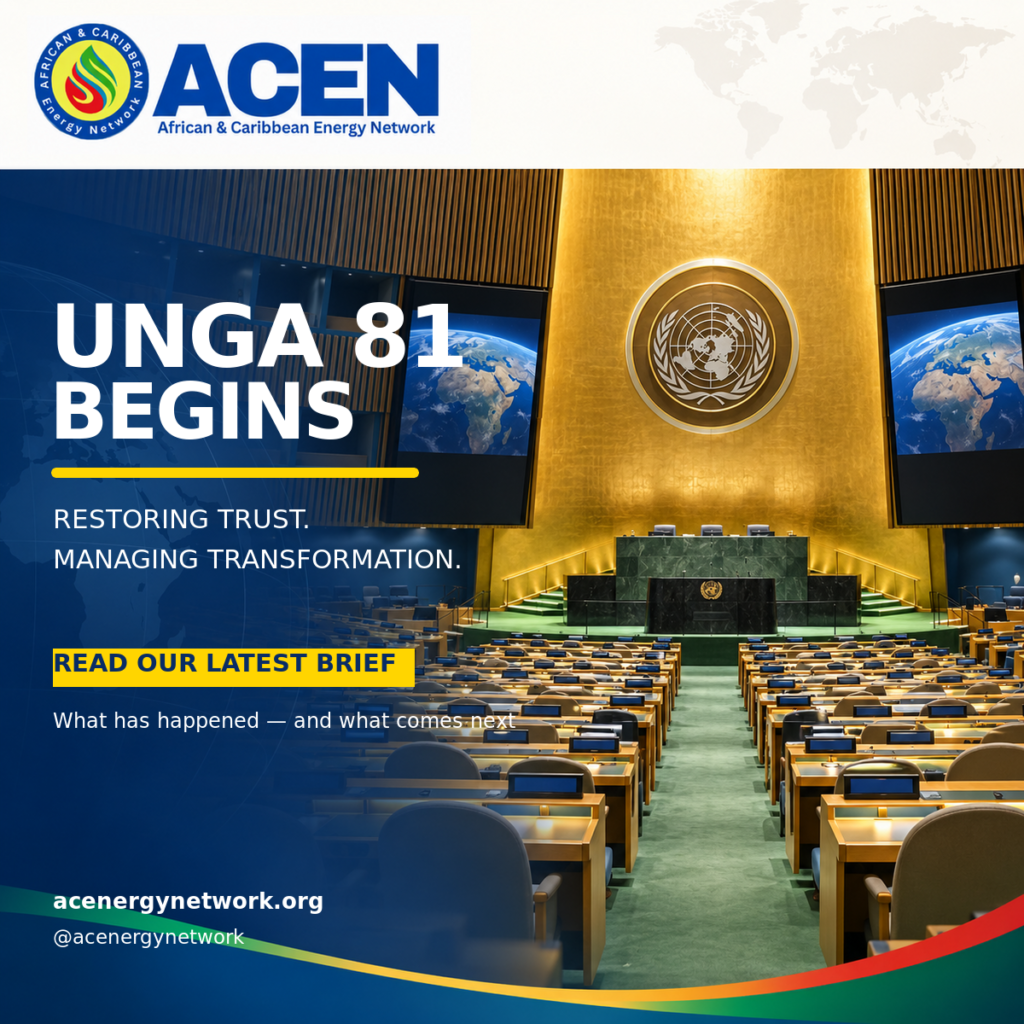
UNGA 81 Begins: Restoring Trust and Advancing Global Action
The 81st Session of the United Nations General Assembly has opened in New York, setting the stage for critical discussions on peace, sustainable development, climate action, energy security and reform of the international system.
The 81st Session of the United Nations General Assembly officially opened on September 8, 2026, at United Nations Headquarters in New York.
Although the session is now underway, the annual General Debate—when presidents, prime ministers and other national representatives address the Assembly—will not begin until September 22. The opening period is being used to establish the Assembly’s agenda, organize meetings and prepare the declarations and national positions that will shape the coming year.
Khalilur Rahman of Bangladesh has assumed the presidency of the General Assembly for its 81st session. His presidency will be guided by the theme:
“Restoring Trust, Managing Transformation: A United Nations that Delivers for All.”
The theme reflects the difficult international environment in which UNGA 81 is taking place. Armed conflicts, climate disruption, widening inequality, strained humanitarian resources, rapid technological change and declining confidence in international institutions are placing the multilateral system under considerable pressure.
A call to rebuild trust
During the opening, United Nations Secretary-General António Guterres described rebuilding trust in the multilateral system as one of the defining challenges of our time.
He drew attention to continuing conflicts, the danger of nuclear escalation, persistent poverty and inequality, worsening climate disruption, near-record levels of displacement and slow progress toward the Sustainable Development Goals.
The Secretary-General also raised concerns about declining humanitarian and development funding, weakening respect for international law and human rights, and the need for responsible governance of artificial intelligence.
At the same time, he emphasized that the United Nations remains an essential forum through which countries can address shared challenges through diplomacy, dialogue and cooperation.
Guterres identified the Pact for the Future and the UN80 reform initiative as important foundations for modernizing the United Nations and strengthening its capacity to respond to present and emerging global challenges.
This opening also carries historical significance, as Guterres indicated that it would be his final opening of a General Assembly session as Secretary-General.
The major issues expected to shape UNGA 81
The early agenda for UNGA 81 indicates that several interconnected issues will dominate the session.
International peace and security
Ongoing conflicts, civilian protection, nuclear risks and the consistent application of international law will remain central to the Assembly’s work.
With the Security Council frequently divided, the General Assembly is expected to continue serving as an important platform for countries to express their positions and build broader international support for peaceful solutions.
Sustainable development
With fewer than five years remaining before the 2030 deadline, governments face growing pressure to accelerate implementation of the Sustainable Development Goals.
Discussions will examine financing, partnerships and practical solutions that can reverse stalled progress in areas including poverty reduction, healthcare, education, gender equality, energy access and climate resilience.
Climate action and the just energy transition
Climate change and energy security will be closely connected throughout UNGA 81.
Countries will be expected to address how the world can expand access to reliable and affordable energy while accelerating the transition to cleaner energy systems, strengthening energy security and protecting communities from the worsening effects of climate change.
For developing countries, the just energy transition must recognize different national circumstances and ensure that climate policies do not deepen poverty or restrict opportunities for sustainable industrialization.
Reforming global governance and finance
African, Caribbean and other developing countries are expected to continue calling for a more representative international system.
Priorities include reform of the United Nations Security Council, greater participation in global decision-making and changes to the international financial architecture.
Many developing countries are also seeking fairer access to affordable financing, debt relief, climate finance and investment for infrastructure, energy and sustainable development.
The United Nations Office of the Special Adviser on Africa has identified global-governance reform, transformation of the global financial system, climate finance and sustainable industrialization among Africa’s leading priorities.
Human rights and inclusion
The rights and participation of women, young people and marginalized communities will be important across the UNGA 81 agenda.
The session will also give increased attention to the experiences of Least Developed Countries, Landlocked Developing Countries and Small Island Developing States, many of which face severe economic, environmental and energy vulnerabilities.
Key events coming during UNGA 81
A number of important high-level events will take place before and during the General Debate.
September 17: The Gender Snapshot 2026
UN Women will launch its latest report examining worldwide progress and setbacks affecting women and girls.
The report is expected to provide important evidence on gender equality and the implementation of the Sustainable Development Goals. Information is available through UN Women’s UNGA 81 programme.
September 18: SDG Moment
The annual SDG Moment will highlight transformative action taking place within communities, countries and regions.
It will provide a platform for governments and development partners to examine how progress toward the Sustainable Development Goals can be accelerated despite growing international challenges.
September 22–28: General Debate
Heads of state and government will present their national priorities and positions before the General Assembly.
Their statements are expected to address conflict, peace and security, sustainable development, climate action, global financial reform, artificial intelligence, human rights and the future of multilateral cooperation.
September 23: Climate Action and the Just Transition
This high-level event will bring together leaders from developed and developing countries, vulnerable nations, major economies and leading energy-producing and energy-consuming countries.
The discussions will examine how nations can accelerate the energy transition, strengthen energy security, advance climate justice and protect communities from the accelerating climate crisis.
September 23: The Right to Development
A high-level meeting will commemorate the 40th anniversary of the United Nations Declaration on the Right to Development.
The meeting will focus on human dignity, equality, public participation, economic justice and the equitable distribution of resources.
September 24: Sea-level rise
Global leaders and other stakeholders will meet to address the existential threats posed by rising sea levels.
This meeting is particularly important for Small Island Developing States and low-lying coastal communities across the Caribbean, Africa and other vulnerable regions.
Participants are expected to pursue stronger international cooperation, political commitments and practical solutions for adaptation, resilience and protection from displacement.
September 25: Pandemic preparedness and response
A one-day meeting will seek to strengthen political cooperation on preventing, preparing for and responding to pandemics and other public-health emergencies.
The meeting is expected to conclude with an action-oriented political declaration based on equity, solidarity and intergenerational responsibility.
September 28: The Durban Declaration and Programme of Action
The United Nations will commemorate the 25th anniversary of the Durban Declaration and Programme of Action, one of the world’s leading international frameworks for combating racism, racial discrimination, xenophobia and related intolerance.
The meeting will seek to mobilize stronger public and political support for the Declaration’s full implementation.
September 29: Nuclear disarmament
A high-level plenary meeting will commemorate the International Day for the Total Elimination of Nuclear Weapons.
The discussions will take place amid increasing international concern about nuclear escalation, non-proliferation and the weakening of global disarmament efforts.
Why UNGA 81 matters for Africa and the Caribbean
UNGA 81 provides an important platform for African and Caribbean countries to advance shared priorities.
These include expanding access to affordable energy, mobilizing climate and development finance, reforming global institutions, protecting vulnerable coastal communities and ensuring that developing countries have a meaningful role in decisions affecting their futures.
The high-level meetings on climate action, the just transition and sea-level rise will be especially important for countries confronting energy poverty while also experiencing some of the most severe consequences of climate change.
The UN Global Compact’s programme of activities also includes an Africa–Caribbean Leadership Forum focused on sustainable growth, investment and resilient value chains. The forum reflects the growing importance of stronger cooperation between the two regions.
ACEN’s perspective
The African & Caribbean Energy Network will closely follow UNGA 81, particularly its discussions on SDG 7, climate finance, energy security, sustainable industrialization and the just energy transition.
Access to reliable, affordable and sustainable energy must remain at the center of the global development agenda. Energy access supports healthcare, education, food security, digital inclusion, entrepreneurship, job creation and community resilience.
Climate action and universal energy access must not be presented as competing priorities. A successful and just energy transition must deliver both—protecting the planet while expanding opportunities for people and communities that have historically been underserved.
As UNGA 81 progresses, ACEN will continue to advocate for solutions that connect global commitments with measurable improvements in the lives of people across Africa, the Caribbean and the wider Global South.
The decisive phase of UNGA 81 will begin with the SDG Moment on September 18 and intensify when the General Debate opens on September 22.
Official meetings and events can be followed through the UNGA 81 High-Level Week portal, the United Nations Journal and UN Web TV.
Published by the African & Caribbean Energy Network
acenergynetwork.org