East Africa’s Clean Energy Transition: Kenya, Tanzania & Ethiopia Lead the Way in 2026
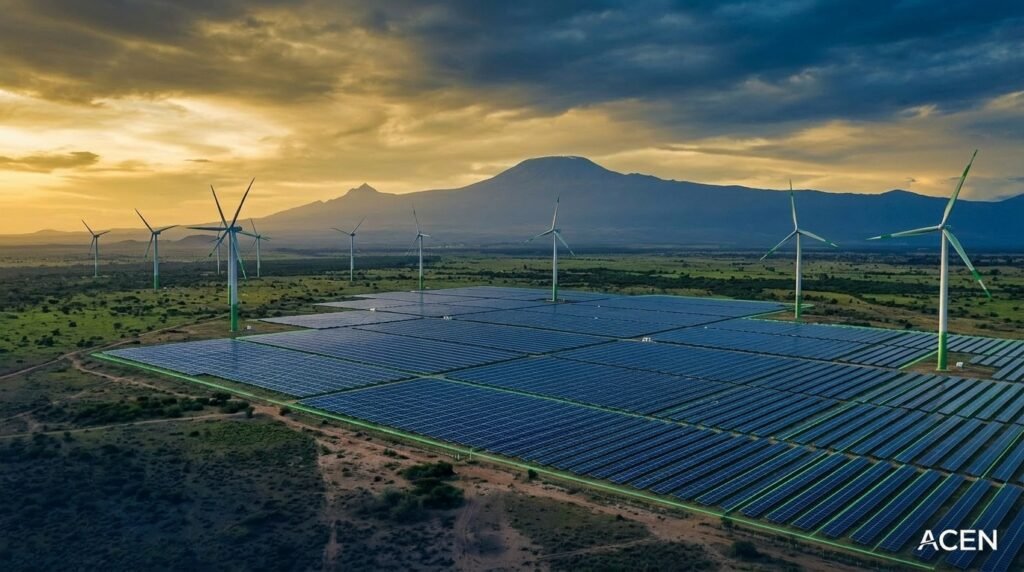
East Africa is home to three of the continent’s most ambitious clean energy stories. Kenya has pushed its electricity mix to over 92% renewables, making it one of the greenest grids on the planet by share. Ethiopia has brought the Grand Ethiopian Renaissance Dam online — 5,150MW of hydro capacity, the largest in Africa. Tanzania is leveraging its natural gas reserves as a transition bridge while rapidly scaling solar mini-grids to electrify thousands of off-grid villages. As HLPF 2026 opens on July 7 with SDG 7 under formal in-depth review for only the second time since 2015, East Africa’s trajectory becomes the continent’s most compelling test case: can African nations lead their own energy transition — not merely receive aid and technical assistance?
Kenya: The Geothermal-Solar Powerhouse
Kenya’s energy story is built on geology. KenGen’s Olkaria geothermal complex in the Rift Valley currently delivers 863MW — the largest geothermal facility in Africa and one of the top five globally — and expansion phases are actively under development. That foundation has enabled Kenya to achieve a renewable electricity mix that most OECD nations cannot match.
The Kenya Power and Lighting Company (KPLC) is simultaneously expanding transmission infrastructure to reduce losses and extend grid reach into peri-urban and rural counties. But transmission remains the country’s most urgent bottleneck. Distribution lines are aging in several regions, and the capital expenditure required to modernize them is competing with generation investment for a limited pool of concessional finance.
Off-grid solar has moved faster. M-KOPA has connected over 3 million households across East Africa to pay-as-you-go solar, with deep penetration in Kenya’s rural counties. d.light has distributed over 20 million solar products across the continent, a significant share in Kenya. Together, these companies have extended energy access far beyond what the national grid can currently reach.
On Kenya renewable energy investment: British International Investment (BII) has committed capital to multiple Kenyan energy assets, and the African Development Bank (AfDB) continues to finance grid and generation upgrades. Kenya’s Vision 2030 energy targets position the country as a regional electricity exporter — a role the East African Power Pool is designed to facilitate. If aging transmission infrastructure is not addressed, that export ambition will remain a prospect rather than a revenue stream.
Ethiopia: Scale and Sovereignty
No single infrastructure project has reshaped East Africa’s energy landscape more than the Grand Ethiopian Renaissance Dam. GERD is now operational at 5,150MW installed capacity — nearly triple Kenya’s entire grid — and when fully ramped, it will be the backbone of Ethiopia’s ambition to become a net electricity exporter to Sudan, Djibouti, Kenya, and eventually beyond.
The Ethiopia energy transition story does not stop at hydro. The geothermal pipeline is substantial: the Corbetti geothermal project is targeting 500MW of installed capacity, and Tulu Moye is moving toward 150MW. Both projects are in the Rift Valley, where Kenya has already proven the geology is commercially viable. If Ethiopia executes on this pipeline, its renewable energy base will be diversified beyond hydro — reducing the seasonal variability risk that large dam systems carry.
The risk picture for private investors is, however, real. Political instability in the Tigray region has created reputational and operational risks that have slowed private capital flows. Currency controls — including restrictions on foreign exchange repatriation — have made commercial deal structures difficult to bankroll. Several developers have paused final investment decisions, waiting for clearer signals from Addis Ababa on regulatory reform.
Despite these headwinds, the fundamentals are exceptional. A government with genuine export revenue incentives, proven geology, and the continent’s largest hydro asset as an anchor — Ethiopia is not a frontier market that requires heroic assumptions to underwrite. It requires patient capital and pragmatic structuring.
Tanzania: Gas Bridge With Renewables Ambition
Tanzania’s energy strategy is explicitly a two-track approach: monetize natural gas reserves as a transition bridge while scaling renewables for domestic access. The Mnazi Bay and Songwe Basin gas fields underpin this bridge strategy, with gas-to-power projects supplying the national grid and reducing dependence on expensive liquid fuel generation.
Tanzania clean energy investment is accelerating on the rural access front. The Tanzania Rural Energy Agency (REA) has set a target of electrifying over 6,000 villages via solar mini-grids and stand-alone systems — a program that, at full execution, would represent one of the largest rural electrification campaigns in Sub-Saharan Africa. Progress has been uneven, with project finance delays and regulatory processing times slowing deployment. But the programmatic intent is clear and the political commitment is real.
The transformational project is the Julius Nyerere Hydropower Project (JNHP): 2,115MW on the Rufiji River, currently under construction. When complete, it will more than double Tanzania’s installed generation capacity and unlock export potential to neighboring grid systems. Project finance timelines have slipped from earlier targets, and regulatory reform — particularly around independent power producer frameworks — remains slower than investors would like.
Tanzania’s challenge is execution pace. The gas bridge strategy is sound; the mini-grid program is well-structured; the JNHP is transformational. Closing the gap between programmatic ambition and deal velocity requires streamlined approval processes and stronger IPP regulatory frameworks.
The East African Power Pool Opportunity
The East African Power Pool (EAPP) is the infrastructure layer that can turn three country-level success stories into a regionally integrated energy market. EAPP has set a 2,000MW interconnection target, with transmission corridors linking Kenya–Ethiopia–Tanzania–Uganda already in various stages of development and financing.
The strategic logic is compelling for private investors. A regional grid creates bankable offtake structures: instead of a single sovereign buyer (with all the associated concentration risk), a developer can sell power into a pool with multiple national utilities as potential counterparties. Regional grid integration also reduces the per-kWh cost of serving demand that is too dispersed or too small to support country-level baseload investment alone.
Kenya–Ethiopia transmission is the most advanced corridor, aligned with GERD export ambitions and Kenya’s surplus geothermal capacity. Tanzania–Kenya and Uganda–Kenya corridors are in planning and early financing stages. EAPP’s progress will be closely watched at HLPF 2026 — regional energy integration is exactly the kind of structural outcome that blended finance instruments are designed to catalyze.
HLPF 2026: East Africa Under the Spotlight
When the High-Level Political Forum on Sustainable Development opens at UN Headquarters in New York on July 7, 2026, SDG 7 — Affordable and Clean Energy — will be under formal in-depth review. Kenya is presenting a Voluntary National Review (VNR) at HLPF July 7–15, which means its energy commitments, access metrics, and financing gaps will be scrutinized by member states, development banks, and civil society organizations simultaneously.
This is a policy window. The commitments made in the rooms and side-events during HLPF week will shape blended finance structures, bilateral agreements, and multilateral financing priorities for the next two to three years. ACEN members working in East Africa need intelligence on these conversations — not retrospective summaries. For deeper context on what SDG 7 accountability looks like at HLPF, see ACEN’s dedicated page at acenergynetwork.org/advocating-for-sdg-7.
How ACEN Keeps You Connected
East Africa clean energy 2026 is not a single story — it is three overlapping national transitions, a regional grid integration program, and a multilateral accountability moment at HLPF, all converging in the same calendar quarter. For energy professionals, ESG investors, and development finance officers, the information asymmetry is significant. The deals, the policy positions, and the financing structures are being shaped by practitioners who are networked into these markets.
ACEN provides that network intelligence. Membership gives you direct connections with East African energy professionals, access to HLPF briefings and side-event analysis, and peer context that turns public announcements into actionable signals for investment or policy work.
For professionals building fluency in the region’s market dynamics, ACEN’s Introduction to Renewable Energy in Africa & the Caribbean course ($35) is the most efficient entry point — covering generation technologies, financing structures, regulatory frameworks, and the SDG 7 accountability landscape across both regions.
ACEN Individual Membership is $300/year. Use code ACEN10 at checkout for 10% off. HLPF opens July 7 — the accountability conversations start that morning. Be a member before the agenda shifts from ambition to reckoning.
Join ACEN — become a member today
African & Caribbean Energy Network (ACEN) — Building the professional infrastructure for Africa and Caribbean clean energy transition.