In the 1990s, vast swathes of sub-Saharan Africa and the Caribbean archipelago skipped the landline telephone era entirely. They never built the copper wire networks that connected households in Europe and North America. Instead, they leapfrogged directly to mobile telephony — and in doing so, they became among the most mobile-first economies in the world. M-Pesa, the mobile money platform that transformed financial inclusion across East Africa, could only have been born in a place that never bothered building a legacy banking infrastructure to protect.
The same dynamic is now unfolding in energy. And the implications are just as profound.
The Leapfrog Thesis: More Than a Metaphor
The leapfrog thesis in energy holds that countries with low electrification rates are not simply behind — they are, in important structural ways, advantaged. They have no coal plants to retire, no centralised grid monopolies to dismantle, no incumbent fossil fuel lobby with decades of sunk capital and political capture to overcome. Their energy infrastructure deficit is, paradoxically, a blank slate. And on a blank slate, you can build the system you want rather than the system you inherited.
The economics now support the thesis emphatically. Solar PV module prices have fallen more than 90% since 2010. Battery storage costs have followed a similar trajectory. The levelised cost of utility-scale solar is now below the cost of new coal and gas generation in most of the world — and in Sub-Saharan Africa and the Caribbean, where diesel generation has historically set the marginal cost of electricity, renewables are dramatically cheaper than the alternative they are replacing.
This is not a theoretical projection. It is already happening on the ground, at scale.
Africa: The Off-Grid Revolution
More than 600 million people in sub-Saharan Africa currently live without access to reliable electricity. For decades, the assumed solution was grid extension — building out centralised transmission infrastructure from existing urban centres into rural and peri-urban areas. The problem was cost and time: the infrastructure required to connect remote communities to national grids is expensive, slow to deploy, and difficult to maintain.
Off-grid and mini-grid solar is changing that calculus entirely. Pay-as-you-go solar home systems — small photovoltaic panels paired with battery storage and financed through mobile money micro-payments — are now providing electricity to tens of millions of households that the national grid may not reach for decades. Companies operating across East and West Africa have demonstrated that commercially viable, scalable off-grid electrification is not a philanthropic project — it is a business model.
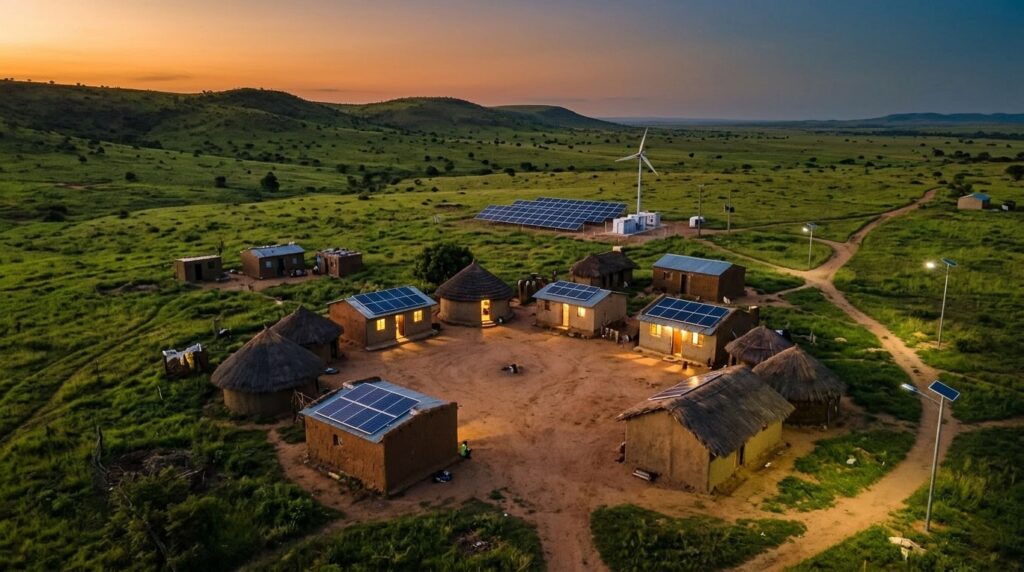
Mini-grids are extending that logic to productive use. Community-scale solar mini-grids — typically 10 to 500 kW of generation paired with battery storage — are being deployed across Nigeria, Tanzania, Kenya, and Rwanda to power not just households but enterprises: grain mills, cold storage, health clinics, schools. The productive use anchor transforms the economics of mini-grid deployment, improving both utilisation rates and the business case for private investment.
The numbers reflect the momentum. The IEA estimates that off-grid and mini-grid solar now provides electricity access to more than 420 million people globally, the large majority of them in sub-Saharan Africa. Annual investment in off-grid energy has reached billions of dollars, drawing institutional capital from development finance institutions, impact investors, and increasingly, commercial asset managers seeking exposure to African growth markets.
The Caribbean: From Diesel Dependency to Renewable Self-Sufficiency
The Caribbean energy transition story is different in character but equally compelling in direction. Caribbean island states are not primarily facing an access deficit — most have relatively high electrification rates. Their challenge is cost, reliability, and carbon intensity. Diesel generation dominates across the region, producing electricity at costs that are among the highest in the world per kilowatt-hour. Those costs are not just an economic burden — they are a structural drag on every business, every hospital, every school that depends on power.
The leapfrog dynamic here is about replacing expensive fossil infrastructure with cheaper, cleaner alternatives — and doing so fast enough to capitalise on falling technology costs before locking in new diesel capacity.
Several Caribbean nations are leading the way.
Barbados has committed to 100% renewable electricity by 2030 — a binding target backed by policy reform, utility restructuring, and a procurement pipeline that has already attracted international solar and storage developers. Jamaica has conducted successive renewable energy auctions, adding utility-scale solar and wind capacity that is displacing diesel at the margin. Saint Kitts and Nevis is targeting 100% renewable electricity by 2025. Across the eastern Caribbean, the economics have tipped: solar plus storage is now the cheapest source of new generation on virtually every island grid.
The IDB, the Caribbean Development Bank, and bilateral development finance institutions from the US, EU, and UK are all actively financing Caribbean renewable energy projects. The Caribbean Climate Smart Facility has been specifically designed to de-risk transactions that commercial capital alone cannot execute. The financial architecture is maturing alongside the technology.
What Leapfrogging Actually Requires
The leapfrog narrative is powerful — but it should not be read as automatic or inevitable. Three enabling conditions must be in place for the transition to happen at the speed and scale that closing the energy gap requires.
Policy clarity. Renewable energy deployment requires long-term revenue certainty. Independent Power Producers need offtake agreements. Distributed solar developers need net metering frameworks. Off-grid companies need a regulatory environment that permits mobile money integration and community mini-grid ownership. Where governments have provided that clarity — as Barbados and Kenya have done — investment has followed. Where regulatory uncertainty persists, capital waits.
Financing that reaches the last mile. Utility-scale solar attracts private capital relatively easily now — the risk-return profile is understood, the technology is proven, and the deal structures are well-developed. The harder problem is financing off-grid systems, clean cooking solutions, and productive use mini-grids for the communities most disconnected from energy access. That requires concessional capital, patient capital, and blended finance structures that de-risk private investment in markets that commercial lenders will not serve alone.
Local technical capacity. Energy systems need to be installed, maintained, and operated by people who live near them. The skills gap in renewable energy across Africa and the Caribbean — solar installation, battery storage management, mini-grid operations, grid integration engineering — is a genuine constraint on deployment speed. Workforce development is not a peripheral issue; it is a critical path item for the energy transition.
The Investment Opportunity
For investors, the leapfrog thesis translates into a specific opportunity: first-mover advantage in markets that are transitioning from high-cost, high-carbon incumbent systems to clean, distributed, low-cost alternatives. The transition is not speculative — it is already underway. The question for investors is not whether it will happen, but who will capture the returns.
The investment universe spans utility-scale renewable generation, battery storage, grid modernisation, distributed solar and storage platforms, mini-grid developers, clean cooking companies, and the enabling infrastructure — financing platforms, digital metering, mobile money integration — that makes all of it work at the last mile.
Development finance institutions have been the first movers. Commercial capital is following. The window for positioning — before competitive dynamics compress returns and before the most attractive project pipelines are claimed — is open now. It will not remain open indefinitely.
ACEN’s Role in the Transition
The African & Caribbean Energy Network exists to accelerate this transition — by connecting the investors, developers, policymakers, and professionals who are doing the work, and by building the human capital that makes the work possible.
Our courses equip energy professionals with the technical and policy knowledge the transition demands. Our membership network connects investors with deal flow, and project developers with financing relationships. Our regional coordinators, active across West Africa, Nigeria, and the Caribbean, provide the on-the-ground intelligence that turns the macro opportunity into specific, actionable engagements.
The energy gap is real. So is the momentum to close it. The leapfrog is not a metaphor — it is a strategy. And ACEN is built to help you execute it.
Join ACEN and be part of the network closing the energy gap →
Published by the ACEN Editorial Team. The African & Caribbean Energy Network (ACEN) is a membership-based platform connecting investors, policymakers, and energy professionals across Africa, the Caribbean, and the global diaspora. For membership inquiries, contact info@acenergynetwork.org.