
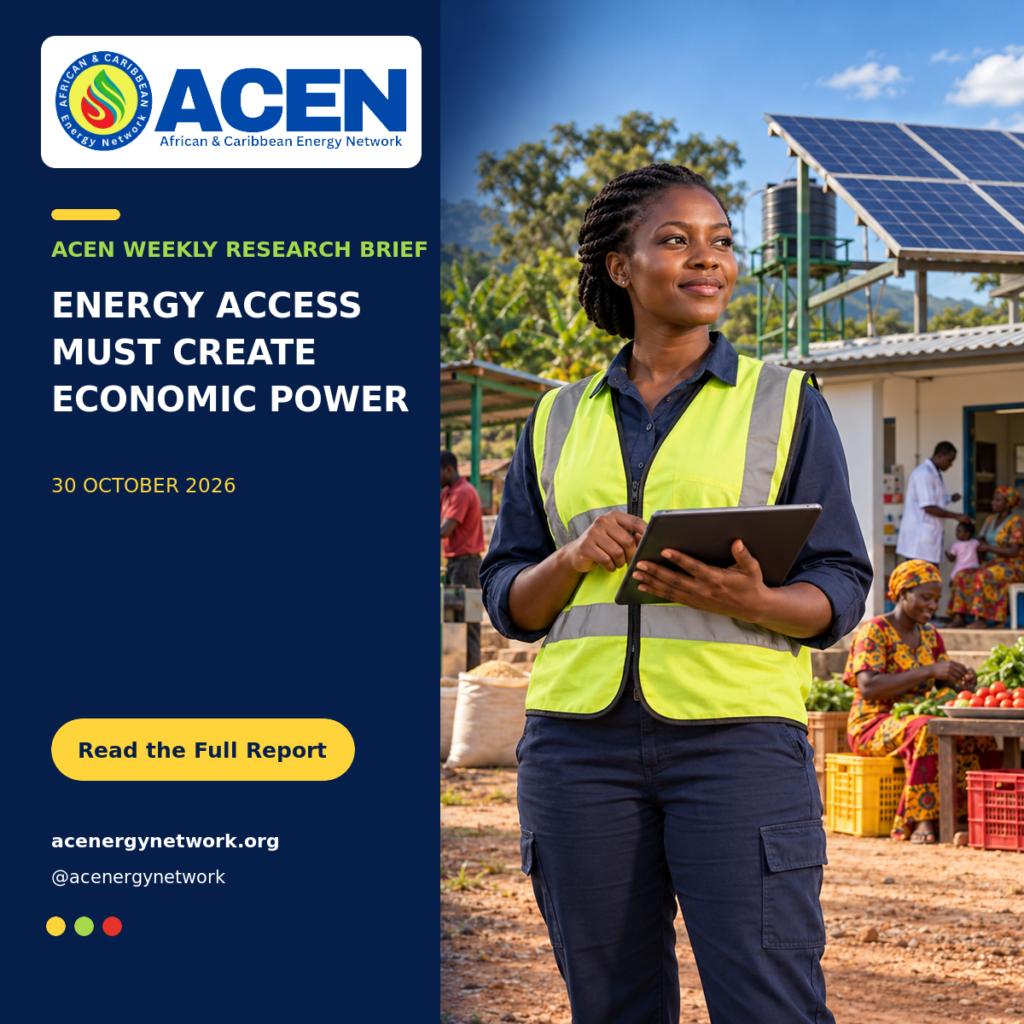
Energy access is sometimes reduced to a single question: is a household connected?
This week’s evidence asks a more useful question: what can people do with the energy they receive? Can a farmer irrigate crops, a clinic protect medicine, a woman grow her business, or a household withstand the next fuel-price shock?
New reports released this week show that distributed solar is becoming essential infrastructure, but affordability remains the decisive barrier. They also demonstrate that women benefit most when inclusion is built into financing, employment and measurement from the beginning.
Off-grid solar has become essential infrastructure
Genuinely new — published 27 October 2026
The Off-Grid Solar Market Trends Report 2026, released by the World Bank Group’s Energy Sector Management Assistance Program and GOGLA, finds that the number of people using off-grid solar products rose by 26% in two years, from 118 million to 149 million.
The report identifies off-grid solar as the least-cost electricity solution for at least 398 million people. It now powers homes, farms, schools, clinics and small businesses—services that make it infrastructure, not simply a temporary substitute for the grid.
The sector is also supporting livelihoods. Approximately 7.4 million people use off-grid solar for microenterprises or income-generating activities, while the surveyed market employs 219,000 people. Among customers surveyed, 95% reported that their solar home systems were still functioning after four years or longer.
Yet cost remains a serious barrier. Only one-third of households without electricity can afford an entry-level solar home system through pay-as-you-go finance; another third could afford one only with difficulty.
ACEN will advocate for distributed renewable energy as permanent public infrastructure, supported by quality standards, local maintenance, consumer protection and targeted affordability measures for underserved households and communities.
Read the World Bank and GOGLA announcement and access the full report
Rwanda shows how solar access can reach women and create jobs
Recent analysis newly relevant to the new off-grid solar findings — published 22 October 2026
World Bank analysis of Rwanda’s Renewable Energy Fund offers a practical lesson in inclusive programme design. Rwanda’s electricity access rate grew from 6% in 2009 to an estimated 85% in 2025, but the programme initially struggled to reach women and low-income households.
The approach changed when a results-based financing window introduced partial grants, removed collateral and formal credit-history requirements, and gave greater support to households facing the largest affordability gaps.
By the programme’s closure, more than two million people had benefited, 52% of them women. Women also held 45.4% of jobs across the 24 participating solar companies, far exceeding the programme’s original 10% target.
This is an important model because it connects energy access with agency. Women were not counted only as household beneficiaries; they became technicians, coordinators, customer-service professionals and entrepreneurs within the solar value chain.
ACEN will promote energy programmes that set measurable gender targets, reduce financial barriers and connect women to paid technical work, enterprise support, procurement and leadership.
Read the World Bank analysis on Rwanda’s solar expansion
Ethiopia’s renewable strength must translate into reliable access
Genuinely new — published 27 October 2026
The International Energy Agency’s new Ethiopia 2026 Energy Policy Review describes a country with a predominantly renewable electricity system, rapidly expanding generation and significant potential for regional power trade.
Installed renewable capacity grew ninefold between 2004 and 2024. Yet the review also shows why generation alone cannot define progress. Ethiopia’s current national targets aim for 75% electricity access and 58% clean-cooking access by 2030—meaning millions could still remain without essential energy services.
The IEA calls for stronger implementation, investment mobilisation, reliable service and faster expansion of electricity and clean cooking. The broader lesson for Africa is clear: large generation projects must be matched by last-mile infrastructure, affordable connections and energy services people can use productively.
ACEN will continue to connect national energy ambition with community-level outcomes—reliable electricity, clean cooking, productive use, local jobs and access for rural and low-income households.
Read the IEA’s Ethiopia 2026 Energy Policy Review
Rising energy prices make Caribbean resilience more urgent
Genuinely new — published 28 October 2026
The World Bank’s Commodity Markets Outlook, October 2026 projects that global energy prices will rise by 32% in 2026, reversing three years of declines. Brent crude oil is forecast to average USD 91 per barrel this year, with further risk if geopolitical disruptions intensify.
For fuel-importing Caribbean economies, this is not an abstract global trend. Higher oil prices can pass through to electricity, transport, food and the cost of running a small business. Households with the least financial flexibility face the greatest pressure.
The report strengthens the case for distributed renewable energy, storage, efficiency and targeted household protection. Energy resilience should be measured by how effectively a system shields people from global shocks—not only by the amount of renewable capacity installed.
ACEN will advocate for Caribbean energy strategies that reduce imported-fuel exposure, lower household vulnerability and direct public support toward the people and small businesses most affected by price increases.
Read the World Bank’s Commodity Markets Outlook, October 2026
ACEN’s perspective
This week’s evidence points to one central principle:
Energy access must create economic power—not merely electrical connections.
Off-grid solar is ready to serve as lasting infrastructure, but public policy must make it affordable. Gender inclusion works when it is built into finance, employment and accountability. National renewable-energy ambition matters only when communities receive reliable and useful services. Caribbean resilience requires reducing the direct line between global oil shocks and household hardship.
ACEN will keep pressing for energy systems that people can afford, women can help lead, local businesses can use and communities can trust.
African & Caribbean Energy Network
Ending Energy Poverty. Advancing SDG 7.
acenergynetwork.org
Social media: @acenergynetwork