The latest research points to a clear challenge for Africa and the Caribbean: clean-energy investment and renewable capacity must translate into affordable, reliable electricity for households, clinics, schools, farms and small businesses. Energy access is not simply a supply target. It is a foundation for health, education, jobs, enterprise and resilience.
New research and developments
1. New report — Africa’s share of clean-energy investment remains far too small
Published 7 November 2026; launched at COP31 on 10 November 2026. Sustainable Energy for All (SEforALL), working with the Australian Government’s Department of Climate Change, Energy, the Environment and Water, released The Electrification Opportunity: Delivering Energy Security, Development and Climate Action in Emerging Markets and Developing Economies.
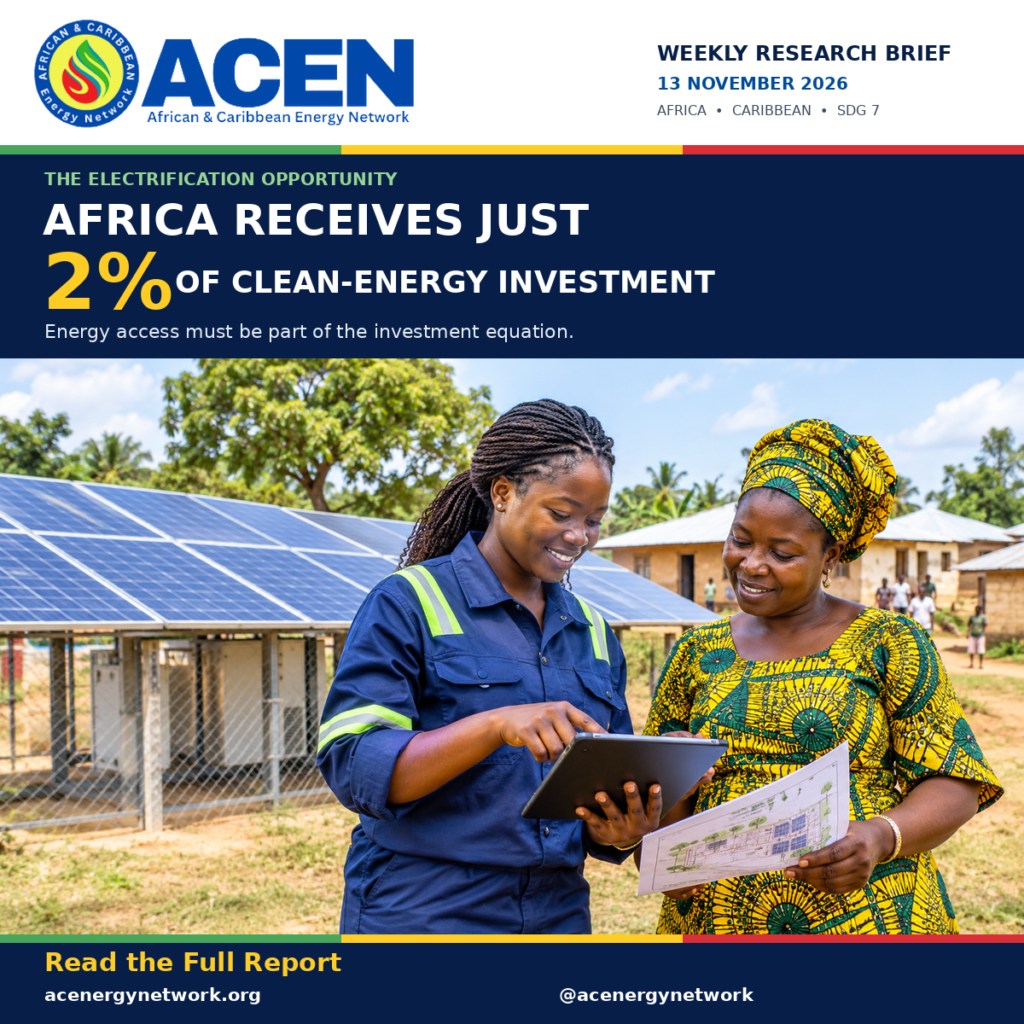
The report says that around 90% of global energy-transition investment remains concentrated in advanced economies and China, while Africa receives only about 2% of clean-energy investment despite its significant share of global electricity-demand growth. It also estimates that technologies available today could electrify approximately 75% of global final energy demand across transport, buildings and industry. The report identifies seven enabling conditions, including integrated planning, finance, clean electricity supply, modern grids and storage, supportive policy, and investment in skills and industrial capacity. It stresses that women and young people must be central to workforce and entrepreneurship strategies.
Why it matters: Africa cannot turn rising demand into broad-based development if investment bypasses the communities and enterprises that need modern energy. The report’s central lesson is that electrification must be planned alongside agriculture, industry, transport, cooking and public services—not treated as an afterthought to generation expansion.
Read the report — SEforALL · Read the 10 November launch announcement
2. New report — Sub-Saharan Africa’s renewable-capacity outlook improves
Published 6 November 2026. The International Energy Agency’s Renewables 2026 forecast revises Sub-Saharan Africa’s renewable-capacity expansion outlook up by 54% for 2026–2031, with solar photovoltaic expected to account for more than 80% of new capacity. The IEA also expects off-grid solar PV capacity growth to accelerate, led in part by Sub-Saharan Africa.
The IEA cautions that grids must keep pace with new renewable generation. Across the world, 3,000 GW of advanced-stage renewable and storage projects are waiting for grid connections.
Why it matters: The stronger outlook creates an opportunity for distributed solar, mini-grids and productive-use systems, but capacity forecasts are not the same as new household connections. Affordable connections, reliable distribution networks, storage, maintenance and local skills will determine whether people benefit.
Read Renewables 2026 — IEA · Read the IEA’s 6 November summary
3. New report — Healthcare facilities still face a major electricity gap
Published 29 October 2026. SEforALL and the United Nations Development Programme released the State of the Market Report for Healthcare Facility Electrification: 2026 Update. Its database maps 426 initiatives across 73 countries and finds that at least 286,170 healthcare facilities worldwide still need first-time electrification or reliable backup power. The report estimates that US$2.67 billion in upfront investment is needed to close the remaining gap in Sub-Saharan Africa alone.
Why it matters: Reliable electricity is essential for vaccine refrigeration, safe childbirth, diagnostics, lighting, communications and emergency care. Electrifying a clinic is not complete if the system is too small, unreliable or unsupported by maintenance and backup arrangements.
Read the report — SEforALL and UNDP
4. New Caribbean financing agreement — Lowering the upfront cost of clean energy
Published 3 November 2026. The Caribbean Development Bank and Green Climate Fund signed an agreement unlocking US$68.7 million for households and businesses in Barbados, Belize and Jamaica. Under an Integrated Utility Services model, utilities will provide upfront financing for eligible rooftop solar (with or without batteries), solar water heaters, efficient air-conditioning and LED lighting. Customers repay through their monthly electricity bills.
Why it matters: High upfront costs keep many households and small firms from investing in clean energy and efficiency. This model could widen access, but its success will depend on transparent repayment terms, consumer protections and designs that do not deepen energy hardship for low-income customers or exclude renters and smaller enterprises.
Newly relevant: women-led and community-centred solutions
Clean cooking for women-run food businesses — announced 29 October 2026. CLASP launched the Cooking Livelihoods and Income for Microenterprises (CLiME) programme in Kenya and Uganda. It is designed to build the supply chains, financing tools and policy support needed to bring modern clean-cooking solutions to food vendors, many of whom are women. CLASP notes that Sub-Saharan Africa has an estimated 44 million micro, small and medium enterprises, most of them micro; food businesses in Nairobi employ about 70,000 people and cook for more than a third of the city’s population daily. This is a recent programme announcement, not yet an evaluation of results.
Women’s leadership in the Caribbean — announced 19 October 2026. The Caribbean Development Bank reported that the 2026 Women in Renewable Energy Fellowship brings together 13 women from 10 Caribbean countries for mentorship, leadership development, technical training and regional networking. This is a useful reminder that women must be able to shape energy policy, lead projects and access technical and commercial opportunities—not simply be counted as beneficiaries.
ACEN’s perspective
ACEN will continue to advocate for energy investments that reach underserved communities and deliver measurable public value. We will elevate women’s leadership and community participation, support attention to clean cooking and productive uses of energy, and call for transparent reporting on affordability, reliability, health and education services, jobs and local enterprise. The measure of progress is not only how much new capacity is built, but who can use the energy, what it costs and what opportunities it makes possible.
African & Caribbean Energy Network (ACEN)
acenergynetwork.org · @acenergynetwork