Ending energy poverty and advancing SDG 7 across Africa and the Caribbean
This week’s evidence points to a clear test for the energy transition: new capacity and connections must translate into affordable, dependable energy for households, public services and local businesses. Women and community enterprises must be part of the decisions—and share in the economic benefits.
New this week
1. The global electricity-access gap is still concentrated in Sub-Saharan Africa
New report — International Energy Agency, World Energy Outlook 2026, published 19 November 2026.
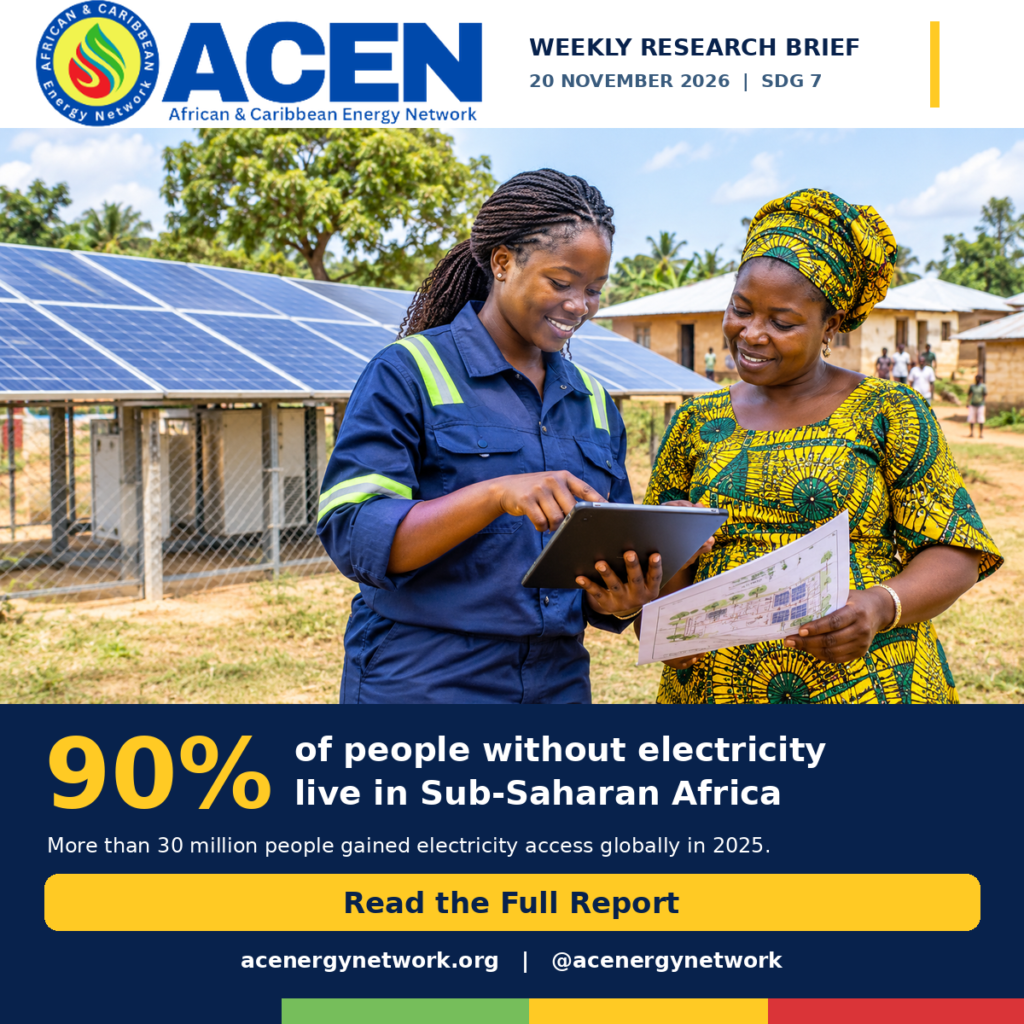
The IEA reports that more than 30 million people gained electricity access globally in 2025, bringing the number still without electricity to around 720 million. Sub-Saharan Africa accounted for about three-quarters of the improvement, yet remains home to 90% of people worldwide without electricity. Off-grid systems—including solar home systems and mini-grids—helped extend access in remote areas, but the IEA notes that uptake can be skewed towards wealthier communities.
The clean-cooking picture is equally urgent. Nearly 12 million people in Sub-Saharan Africa gained access in 2024, but population growth meant the number still without clean cooking rose by around 14 million that year. In the IEA’s accelerated-access scenario—not a forecast—annual investment needs reach about US$24 billion for electricity access and US$4 billion for clean cooking; electricity-access investment would need to increase sixfold.
Why it matters: the report makes affordability and last-mile delivery central. It also warns that higher imported-fuel prices can push households back towards polluting fuels. A durable SDG 7 response must combine grid expansion, decentralised renewables, storage, consumer finance and a wider range of clean-cooking options.
Read the IEA World Energy Outlook 2026 · IEA publication announcement, 19 November 2026
2. Dominica’s geothermal plant demonstrates the value of firm, locally available power
New project outcome — Caribbean Development Bank, published 18 November 2026.
The CDB reports that Dominica’s 10.3 MW geothermal project has reached commercial operations and is expected to supply up to 70% of the island’s annual electricity needs. The Bank says increased geothermal generation has already contributed to a substantial decline in electricity fuel surcharges. The project was financed through a blend of concessional climate finance, regional development financing and private-sector investment.
Why it matters: locally available, firm renewable power can reduce exposure to imported diesel and volatile fuel prices. The next measure of success is whether households and businesses continue to see reliable service and lasting affordability gains.
Read the Caribbean Development Bank update, 18 November 2026
Older research newly relevant
3. Women’s participation must be designed into energy programmes
United Nations Economic Commission for Africa report, published 28 October 2026.
Gendering the Clean Energy Transition in Africa: Unlocking Women’s Participation in Clean Energy documents how women continue to face disproportionate energy-poverty burdens, including limited electricity and clean-cooking access, health risks, time poverty and restricted economic opportunities. It argues that gender-responsive planning is essential to an inclusive transition.
This report is newly relevant alongside the IEA’s latest access findings: without women’s participation in planning, financing, technical work and ownership, energy expansion can leave existing inequalities intact.
Read the UNECA report and download the publication
4. Electric cooking and electricity access should be planned together
Substantive analysis — Loughborough University / Modern Energy Cooking Services, published 9 November 2026.
The analysis explains how electric cooking can create predictable demand for utilities, strengthen the case for grid and mini-grid investment, and reduce reliance on expensive or polluting fuels when appliances and financing are accessible. It reports that coalition partners have supported clean-cooking strategies in 12 countries, with implementation groups active in Kenya, Nigeria, Rwanda, Ethiopia and Madagascar.
A related programme launch from CLASP, announced 29 October 2026, is bringing clean-cooking solutions to food businesses in Kenya and Uganda. CLASP notes that many food vendors are women-run and that Nairobi’s food businesses employ about 70,000 people while cooking for more than a third of the city’s population each day. This is a programme launch, not an impact evaluation; its importance is the opportunity to improve working conditions and productivity in women-led microenterprises.
Read the analysis, 9 November 2026 · Read CLASP’s programme announcement, 29 October 2026
ACEN’s commitment
ACEN will continue to advocate for energy investments that reach underserved households and communities, lower the cost of essential energy services, and strengthen reliable electricity and clean cooking. We will elevate women as decision-makers, entrepreneurs, technicians and owners—not only as beneficiaries—and call for transparent reporting on affordability, reliability, local jobs and community outcomes.
The measure of progress is not simply how much energy infrastructure is built. It is whether people can afford to use it, depend on it, and turn it into better health, education, and livelihoods.
African & Caribbean Energy Network (ACEN)
acenergynetwork.org · @acenergynetwork