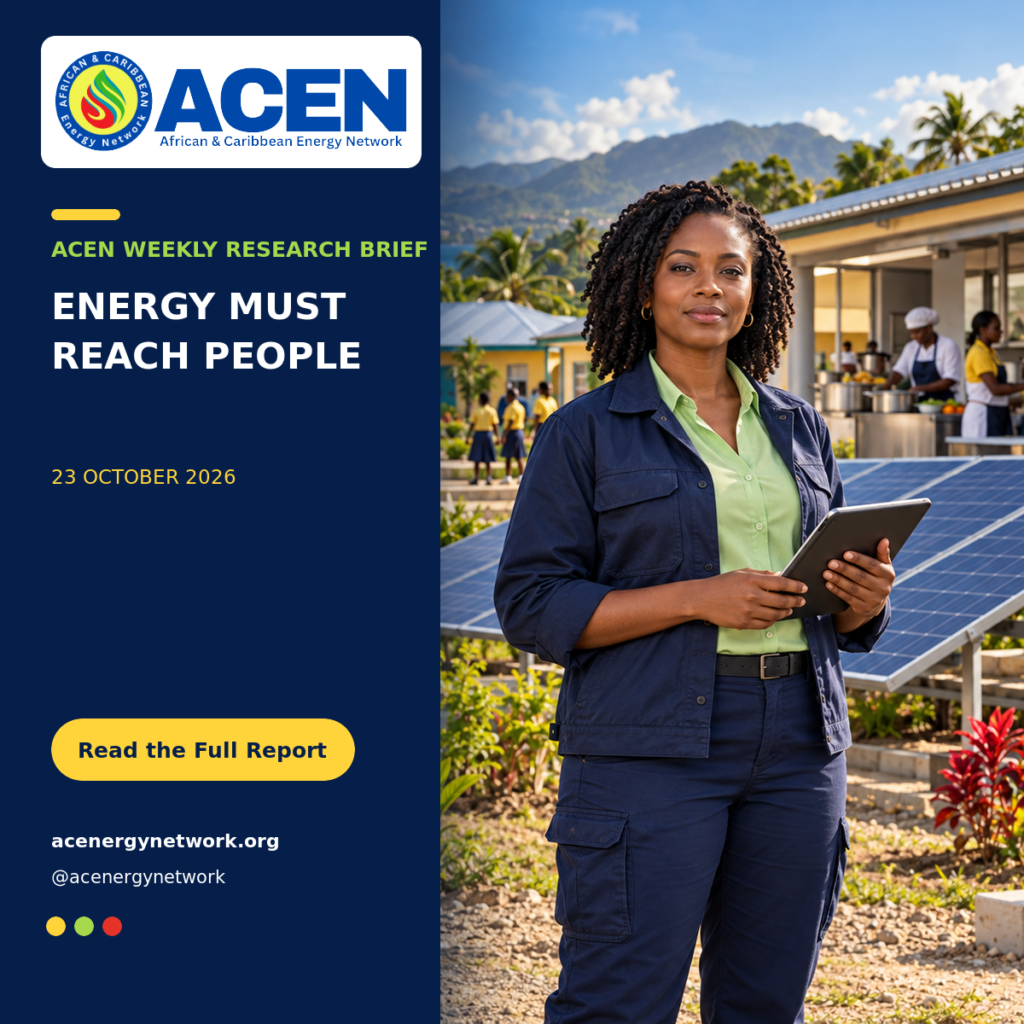
Energy progress is meaningful only when people can feel it in daily life: in a kitchen free from smoke, in a reliable business connection, in a household protected from price shocks and in an energy sector where women are equipped to lead.
This week’s strongest evidence makes that standard especially clear. A new analysis shows that the centre of the global clean-cooking challenge has shifted to Africa. New initiatives in Africa and the Caribbean are opening technical and leadership pathways for women. At the same time, fresh development research warns that energy-price shocks and weak investment conditions can erase gains before communities ever experience them.
Africa now carries half of the global clean-cooking gap
Genuinely new — published 22 October 2026
Sustainable Energy for All’s new analysis of the 2026 Tracking SDG7 data finds that about 997 million people in Africa lacked clean cooking in 2024, up from 791 million in 2010. Africa now represents 50% of the global gap and, if current trends continue, could account for roughly 69% by 2030.
The problem is not a lack of workable solutions. Nigeria, Kenya and Ghana together have added clean-cooking access for about 85 million people since 2010. School kitchens also offer an important route to scale: pilots in Lesotho cut fuel costs substantially by shifting to electric pressure cookers, while programmes in Tanzania and Kenya are bringing cleaner cooking to public institutions.
This matters because cooking smoke harms health, consumes women’s and girls’ time and deepens pressure on household income and forests. Clean cooking must therefore be treated as essential energy infrastructure, not a secondary household issue.
ACEN will champion clean-cooking programmes that are affordable to use, designed with women and communities, supported by dependable energy supply and measured by sustained adoption—not simply by the number of appliances distributed.
Read SEforALL’s analysis, Clean Cooking for All by 2030: The Gap Has Shifted
Women need routes into the work—and into leadership
Genuinely new — Africa programme announced 21 October; Caribbean commitment announced 19 October 2026
SEforALL has expanded its women-focused STEM Traineeship Programme into Nigeria and Mozambique. The programme combines technical, digital and analytical training with practical work on energy access. In Mozambique, trainees will support rural development work that includes 300 to 400 productive-use renewable-energy solutions for food, water and livelihoods.
In the Caribbean, the Caribbean Development Bank is supporting the relaunched Women in Renewable Energy Fellowship through CCREEE and the ASERT 2030 programme. The 2026 cohort brings together 13 women from 10 Caribbean countries for mentorship, technical training, professional coaching and regional networking.
Together, these initiatives show what inclusion should look like: women are not presented only as beneficiaries of better energy services. They are engineers, planners, entrepreneurs, mentors and decision-makers shaping how the transition is delivered.
ACEN will support partnerships that connect women’s training to paid work, project responsibility, procurement opportunities, finance, mentorship and long-term leadership. A pipeline is successful only when it leads to real authority and opportunity.
Read the SEforALL announcement on Nigeria and Mozambique
Read the Caribbean Development Bank announcement on women’s energy leadership
Energy-price shocks can reverse development gains
Recent policy brief newly relevant — published 11 October 2026
UNDP’s policy brief No Time to Recover warns that developing countries are facing renewed energy-price pressure alongside high borrowing costs and growing climate risk. Across 130 countries, gasoline and diesel prices had risen by averages of 26% and 38% since the conflict examined in the brief began.
UNDP estimates that full transmission of the combined energy and food-price shock could expose an additional 66 million people to extreme poverty. The figures are potential exposure, not observed poverty increases, but they show why affordability and social protection belong at the centre of energy policy. UNDP estimates that targeted protection for people below $6.85 a day would cost about 0.3% of developing-country GDP—far less than broad universal compensation.
For African and Caribbean households already facing high bills and limited fiscal protection, an energy transition must reduce vulnerability to imported-fuel shocks rather than reproduce it.
ACEN will continue to press for targeted household protection, distributed renewable energy, energy efficiency and financing that strengthens long-term resilience instead of locking communities into recurring price crises.
Read UNDP’s policy brief, No Time to Recover
Renewable investment needs clear rules and patient finance
October report newly relevant to this week’s affordability debate — issued 2 October 2026
A new Inter-American Development Bank survey of renewable-energy project sponsors across Latin America and the Caribbean finds that regulatory and institutional barriers are a leading source of investment risk. Developers pointed to permitting delays, inconsistent application of rules and weak coordination between agencies.
The report also finds that the financing challenge is often less about whether capital exists than whether it is affordable and available for long enough. High costs, short maturities and shallow capital markets can prevent projects from reaching scale.
This distinction matters for the Caribbean. Faster permitting alone will not guarantee public benefit, and new capacity alone will not end energy poverty. Investment frameworks must also reward affordability, reliability, local participation and resilience.
ACEN will advocate for transparent, predictable project rules and long-term finance that gives community organisations, local developers and women-led enterprises a fair opportunity to participate.
ACEN’s perspective
This week’s evidence points to one conclusion: energy progress must be judged by who is protected, who can participate and who gains the power to lead.
Africa’s clean-cooking challenge requires the scale and urgency given to major infrastructure. Women’s training must lead to jobs, contracts and decision-making power. Caribbean investment must produce lower vulnerability and stronger public value. Across both regions, affordability cannot be treated as an afterthought.
ACEN will keep connecting evidence with public purpose so that energy systems do more than add capacity. They must improve health, protect household income, expand opportunity and strengthen community power.
African & Caribbean Energy Network
Ending Energy Poverty. Advancing SDG 7.
acenergynetwork.org
Social media: @acenergynetwork