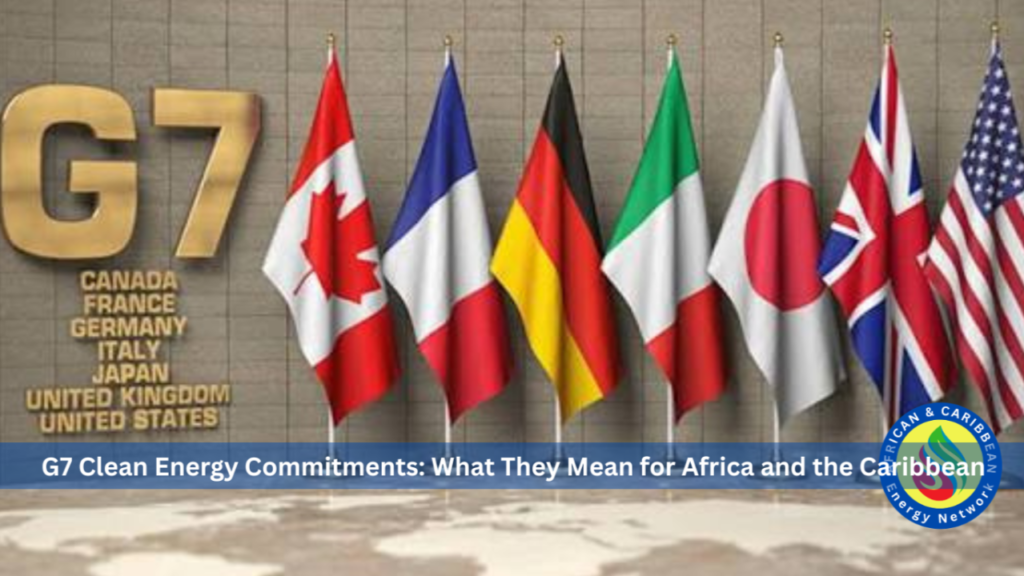
The G7 summit taking place June 13–15, 2026, has placed clean energy transition at the top of the agenda.
For the African & Caribbean Energy Network (ACEN), these commitments carry real-world implications for the regions we serve, where energy access, investment gaps, and climate resilience intersect in ways that demand global attention.
What the G7 Has Pledged
G7 nations have committed to phasing out unabated coal power, accelerating offshore wind deployment, and directing significant financing toward clean energy in developing economies. Key pledges include expanded Just Energy Transition Partnerships (JETPs) and renewed commitments to the $100 billion climate finance goal — this time with a focus on grants over loans. For Africa and the Caribbean, the most consequential commitment is the expansion of the Partnership for Global Infrastructure and Investment (PGII), which targets clean energy, digital infrastructure, and health systems in low- and middle-income countries.
Why This Matters for Africa
Sub-Saharan Africa is home to over 600 million people without reliable access to electricity. Despite possessing some of the world’s richest renewable energy resources — solar irradiance, wind corridors, geothermal potential — the continent has attracted less than 2% of global clean energy investment in recent years. G7 financing commitments, if channelled effectively, could help close this gap. JETPs with South Africa, Senegal, and Nigeria have shown early promise, though implementation challenges — including high borrowing costs and grid infrastructure deficits — remain significant. ACEN’s position is clear: financial commitments must be paired with capacity building, technology transfer, and locally-led governance frameworks. Top-down financing without on-the-ground institutional depth will not achieve SDG 7.
Why This Matters for the Caribbean
Small Island Developing States (SIDS) in the Caribbean face a dual challenge: extreme climate vulnerability and heavy dependence on imported fossil fuels. Diesel generation remains the norm across much of the region, driving electricity costs that are among the highest in the world. G7 commitments to climate adaptation finance and renewable energy deployment in SIDS are particularly relevant here. The Caribbean has made ambitious targets — many islands aim for 100% renewable electricity by 2030–2035 — but the investment pipeline remains thin. ACEN views the Caribbean energy transition as an investment opportunity as much as a development imperative. With the right policy frameworks and international partnerships, the region can leapfrog fossil fuel dependency entirely.
From Pledges to Action: What We’re Watching
At ACEN, we will be monitoring three specific outcomes from the June G7 summit:
- Concessional finance terms — Are new JETP agreements structured with grants and near-zero interest instruments, or are developing countries still expected to absorb high debt burdens for the energy transition?
- Technology transfer mechanisms — Will G7 nations operationalize intellectual property carve-outs for clean technology, enabling local manufacturing in Africa and the Caribbean rather than perpetual import dependency?
- Private sector mobilisation ratios — G7 governments cannot fund the transition alone. We will be watching the leverage ratios between public commitments and private capital mobilised, particularly through development finance institutions (DFIs) like the IFC, OPIC/DFC, and the UK’s BII.
ACEN’s Role
The African & Caribbean Energy Network exists precisely to bridge the gap between high-level policy commitments and on-the-ground implementation.
Our membership, spanning energy professionals, investors, policymakers, and development practitioners across both regions, positions us to translate G7 pledges into actionable partnerships and projects. We invite energy leaders, investors, and institutions aligned with the clean energy transition to join ACEN’s network.
The window for founding membership is open now, and the time to build these relationships is before the next wave of finance begins to flow.