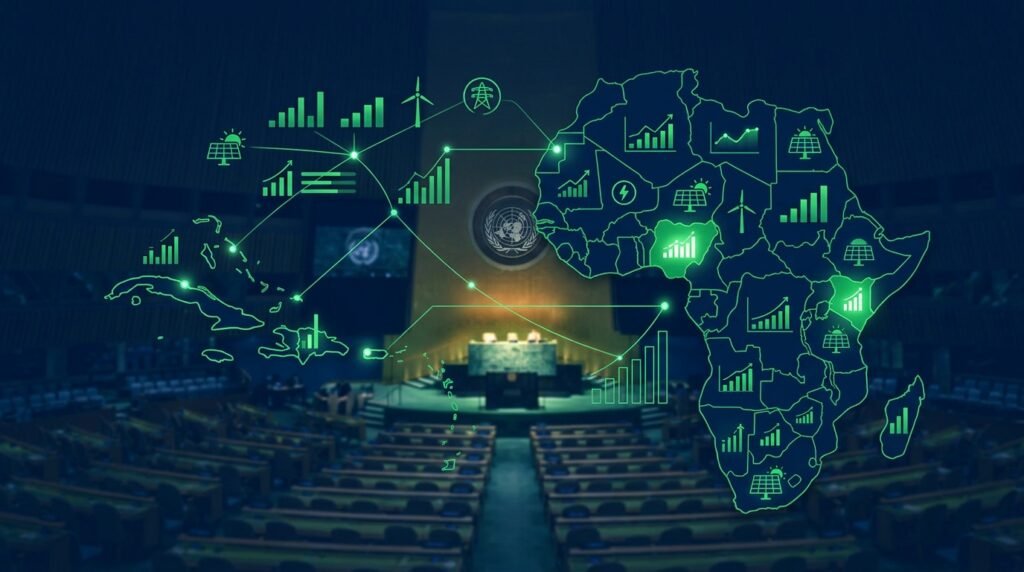
HLPF 2026 opens in 16 days. On July 7, New York becomes the centre of global accountability for the Sustainable Development Goals — and this year, SDG 7 progress in Nigeria, Kenya, and the Caribbean sits squarely in the crosshairs. The High-Level Political Forum on Sustainable Development runs July 7–15, with a three-day ministerial segment from July 13–15. Thirty-six countries will present Voluntary National Reviews. HLPF 2026 puts SDG 7 — affordable and clean energy for all — under formal in-depth review for the first time since 2018.
This is the moment when global pledges meet country-level accountability. For energy investors, professionals, and policymakers tracking the HLPF energy review 2026 as the year’s defining energy policy event, the question is specific: where do ACEN’s core geographies actually stand on the five SDG 7 targets — electricity access, clean cooking, renewable energy share, energy efficiency, and international finance flows? Here is the honest assessment.
SDG 7 Progress in Nigeria: Scale, Gaps, and What’s Moving
Nigeria is Africa’s most populous nation and one of its most complex energy economies. National electricity access sits at roughly 60%, based on IEA Tracking SDG 7 data — but that figure significantly overstates the lived reality. An estimated 85 million Nigerians live without electricity entirely, and tens of millions more face outages so severe and prolonged that grid connection provides little practical benefit. Nigeria runs one of the world’s largest parallel diesel generator economies: an estimated $14 billion per year in private generator spending keeps businesses and households running while contributing to urban air pollution and energy costs that undercut economic productivity across the country.
The rural-urban divide is stark. Urban access rates exceed 80%, while rural electrification falls well below 40% in many states. Solar mini-grids are expanding — Nigeria is home to one of Africa’s most active off-grid markets, with operators including Husk Power Systems and a growing cohort of DFI-backed developers. Nigeria’s Electricity Act 2023 opened the sector to subnational and private investment, creating new regulatory pathways for distributed energy and competitive retail markets. Progress is real.
But the SDG 7 progress Nigeria funding gap persists. The country’s ambitious clean energy targets — including substantial renewable capacity additions toward its 2030 commitments — require investment flows that have not yet materialised at pace. Nigeria’s clean cooking deficit compounds the picture: over 160 million people still rely on traditional solid biomass for daily cooking, with the health, deforestation, and gender equity consequences that entails.
Nigeria is not presenting a VNR at HLPF 2026, but the SDG 7 thematic review will assess country-level data across Sub-Saharan Africa — and Nigeria’s gaps will be visible in the regional aggregate. What to watch: Electricity Act implementation progress, off-grid solar deployment trajectory, and whether Nigeria’s clean cooking financing receives targeted attention in the ministerial declaration.
SDG 7 Kenya: One of Africa’s Best Stories — With a Glaring Blind Spot
SDG 7 Kenya is one of the continent’s most encouraging progress narratives. National electricity access reached approximately 75% by 2023, driven in large part by the Last Mile Connectivity Project that extended grid infrastructure to millions of rural households over the past decade. That positions Kenya among the top performers in Sub-Saharan Africa on electrification rate — and on a credible trajectory toward universal access before 2030.
Kenya’s power generation mix is its most remarkable achievement. Geothermal from the Olkaria complex and the broader Rift Valley contributes approximately 46% of total electricity generation. Add hydropower (~33%) and wind from Lake Turkana — Africa’s largest wind facility — and Kenya draws well over 90% of its electricity from renewable sources. That is an extraordinary clean power mix by any regional standard, making Kenya one of the few African nations that can already point to a genuinely clean grid as an SDG 7 success.
Off-grid solar leadership reinforces the story. M-KOPA, d.light, and other pay-as-you-go pioneers scaled their models in Kenya first, proving the commercial viability of solar access for low-income households and generating the evidence now driving replication across East and West Africa. Energy access Africa 2026 discussions consistently cite Kenya’s off-grid market as the regional benchmark.
But SDG 7 is about more than electricity, and Kenya’s clean cooking gap remains its most significant blind spot. Approximately 85% of Kenyans still rely on wood, charcoal, or agricultural residues as their primary cooking fuel. The household air pollution burden — disproportionately borne by women and children — is Kenya’s starkest remaining energy poverty dimension, and one that the country’s own reporting acknowledges is severely off-track.
What to watch from the HLPF energy review 2026 on Kenya: battery storage scaling to firm the geothermal-wind mix for baseload reliability, green hydrogen positioning (Kenya is pursuing an East Africa hub strategy with active pilot projects), and whether the clean cooking gap receives the same political attention as Kenya’s grid achievements.
SDG 7 Caribbean: Jamaica, St. Kitts & the Financing Barrier
The SDG 7 Caribbean story is defined by a paradox: high electrification rates, punishing energy costs. Most Caribbean island states have household electricity access above 90–95%. But that electricity runs almost entirely on imported diesel and heavy fuel oil, making per-kilowatt-hour costs among the highest in the world and leaving island economies acutely exposed to oil price volatility and supply disruptions.
At HLPF 2026, Jamaica and Saint Kitts and Nevis are presenting Voluntary National Reviews — making this a direct accountability moment for Caribbean energy policy. Jamaica has set a 50% renewables-by-2030 electricity target and has tendered utility-scale solar and wind projects. Saint Kitts and Nevis carries ambitions to reach fossil-fuel-free electricity by 2030. Both nations will confront in New York the same structural barrier: small grid size, limited domestic capital markets, and a persistent financing gap that standard commercial instruments alone cannot bridge.
Beyond the VNR presenters, Barbados continues to lead regional ambition. The Barbados Programme and the Bridgetown Initiative have reframed how Small Island Developing States engage with international climate finance architecture. Barbados’s 100% renewable electricity target by 2030 makes it the region’s policy flagship. In St. Vincent and the Grenadines, geothermal development continues, with the prospect of locally-generated baseload power displacing chronic diesel dependency.
What Caribbean VNR presenters will make explicit at HLPF: financing constraints are the binding barrier. The technology exists. The political will is there. What is missing is a multilateral finance architecture that treats SIDS energy vulnerability — including extreme weather resilience gaps that destroy infrastructure faster than it can be built — as the development emergency it is.
What This Means for ACEN Members
VNR processes are more than accountability reports — they are intelligence documents. They are the structured, public moment when governments lay out their energy strategy, identify financing gaps, and signal which partnerships and investments they are actively seeking. For investors, project developers, and policy professionals, VNRs are a direct window into market readiness and government appetite for clean energy partnerships.
Energy access Africa 2026 and Caribbean transition planning both require professionals who read VNRs, understand what they signal, and are connected to the networks that can act on those signals. That is the intelligence ACEN members are built for. Through Country Coordinators in Nigeria and The Bahamas, and a Regional Chair for the Caribbean, ACEN’s network operates at exactly the intersection where policy commitments translate into project conversations, partnership structures, and investment flows.
The HLPF window — July 7 through 15, with the Ministerial segment July 13–15 — is the moment to be engaged, not watching from the sidelines. Browse ACEN’s curated policy briefs and investment intelligence in the Resource Hub.
Join ACEN Before HLPF Opens
Become an ACEN member before July 7 — use code ACEN10 for 10% off any membership tier. Founding Member rate is available through August 31. Deepen your command of clean energy investment frameworks before the post-HLPF deal window opens with the Clean Energy Investment & ESG course. Browse policy reports, country briefs, and investment guides in the Resource Hub.
HLPF closes July 15. The commitments made in New York will shape energy access priorities — and investment flows — through 2030. Be part of the network that is positioned at the centre of that moment.
Published by the ACEN Editorial Team. The African & Caribbean Energy Network (ACEN) is a membership-based platform connecting investors, policymakers, and energy professionals across Africa, the Caribbean, and the global diaspora. For membership inquiries, contact info@acenergynetwork.org.