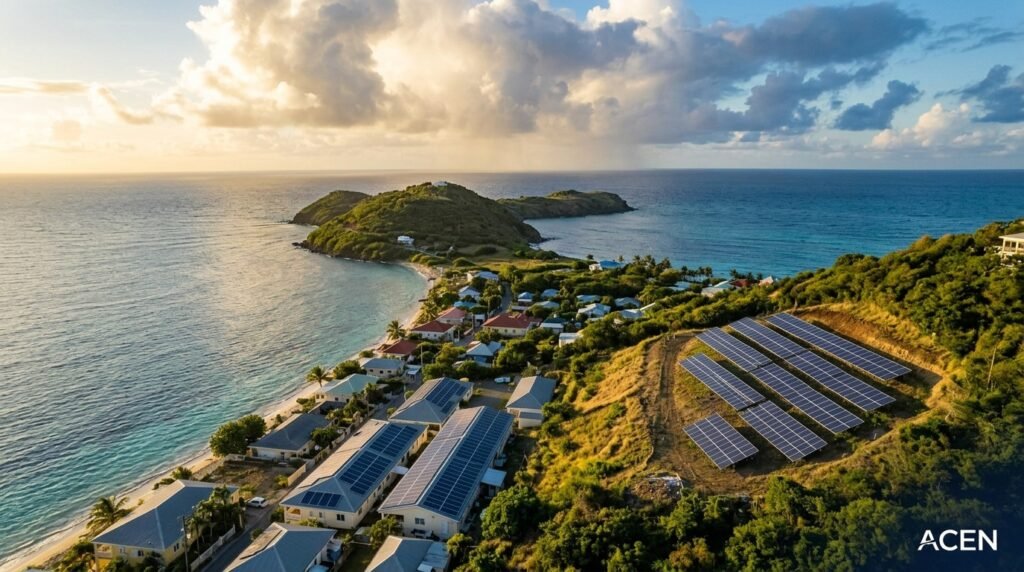
Caribbean households pay between $0.35 and $0.55 per kilowatt-hour for electricity — among the highest rates on the planet. The region sits on vast solar, wind, and ocean energy resources that could power island economies at a fraction of that cost. The mismatch is not technological. The Caribbean has access to proven, cost-competitive renewable energy solutions. The obstacle is capital: how to structure, de-risk, and deliver financing at a scale and speed appropriate to the urgency of the transition. That is the central question shaping Caribbean clean energy financing in 2026.
The CCREEE-IRENA MoU: Why April 2026 Matters
The most significant institutional signal of the year so far came in April 2026, when the Caribbean Centre for Renewable Energy and Energy Efficiency (CCREEE) and the International Renewable Energy Agency (IRENA) signed a new Memorandum of Understanding at the International Vienna Energy & Climate Forum. The agreement was signed by Dr. Mohammad Rafik M.S. Nagdee, CCREEE’s Executive Director, and Francesco La Camera, IRENA’s Director-General, and witnessed by Barbados’s Minister of Innovation, Industry, Science and Technology.
The MoU formalises cooperation on renewable energy deployment, technical assistance, and data sharing across CARICOM member states. More than a diplomatic document, it connects the region’s primary clean energy institution to the world’s foremost intergovernmental renewable energy agency — strengthening CCREEE’s access to IRENA’s global research, policy toolkits, and financing intelligence. For professionals tracking Caribbean energy transition blended finance options, this partnership creates new channels for mobilising technical support at the project preparation stage, where the financing bottleneck is most acute.
The context matters. CARICOM member states collectively had 700 MW of renewable energy capacity installed as of 2025, representing just 12% of the region’s electricity generation mix. The political target is 47% by 2027 — an ambitious jump that requires not just technology deployment but a fundamental shift in how Caribbean energy projects are structured and financed.
The Financing Gap Explained
The disconnect between Caribbean renewable energy targets and the pace of deployment is not a political will problem. Governments across the region — from Barbados to Jamaica to Saint Kitts and Nevis — have set binding or aspirational renewable energy targets. The barrier is structural, and it shows up most clearly at the project preparation stage.
Before a renewable energy project in a Small Island Developing State can attract private capital, it must clear a series of preparatory hurdles: feasibility studies, environmental impact assessments, grid interconnection studies, power purchase agreement negotiations, and credit enhancement analysis. These activities are expensive, time-consuming, and require technical expertise that many small island governments do not have in-house. The financing needed to complete this preparation rarely comes from commercial sources — investors want projects that are already bankable, not projects that still need work to become bankable. This is the chicken-and-egg problem that defines Caribbean energy project development.
The structural disadvantage SIDS face in global capital markets compounds this. Island economies with small GDPs, shallow domestic capital markets, and high exposure to climate-related disasters simply do not register on the radar of most institutional investors. When they do, risk-adjusted returns often don’t compare favourably to opportunities in larger, more liquid markets — even when the underlying renewable energy resource is excellent. Renewable energy investment in SIDS requires the international finance system to make deliberate accommodations for this structural reality, not just wait for market forces to work.
Mechanisms That Are Working
Several financing mechanisms are proving their value in the Caribbean context. The most consequential is blended finance — the combination of concessional public capital with commercial investment to lower the effective cost of capital for projects that would otherwise be too risky or too small to attract private money alone. Public-private partnerships structured through development finance institutions have enabled a growing pipeline of solar and storage projects across the region. Climate resilience funds are increasingly bundled with renewable energy investments, creating hybrid financing structures that address both decarbonisation and disaster preparedness in a single transaction. Community-backed microgrid models, which spread ownership across local stakeholders, have proven particularly effective in outer island and rural contexts where utility-scale approaches are impractical.
Demand aggregation is another mechanism gaining traction. By pooling energy demand across multiple SIDS — coordinating procurement, standardising project specifications, and presenting a combined offtake profile to investors — Caribbean nations can present a more compelling investment opportunity than any single island could offer alone. The logic mirrors what has worked in other small-scale energy markets: aggregation transforms a fragmented landscape of micro-projects into a portfolio that institutional capital can engage with at reasonable transaction cost.
CCREEE’s Project Preparation Facility (PPF) is the most targeted institutional response to the bankability gap. The PPF provides grant financing specifically for the pre-investment work — feasibility studies, environmental assessments, financing structure design — that turns a good project idea into a bankable proposal. It is addressing the market failure that has historically kept Caribbean renewable energy projects on paper rather than in operation.
Key Institutions to Know
Understanding Caribbean clean energy financing in 2026 means understanding the institutional ecosystem. CCREEE is the region’s dedicated clean energy centre, coordinating policy development and providing technical support across CARICOM member states. The Caribbean Development Bank (CDB) is the primary multilateral development finance institution for the region, channelling concessional capital and providing guarantees that improve the risk profile of Caribbean energy investments for commercial co-investors. CARILEC, the Caribbean Electric Utility Services Corporation, connects regional electric utilities and provides the sector intelligence that underpins procurement and regulatory reform.
At the international level, IRENA’s Climate Investment Platform — developed in collaboration with IDB, SEforALL, UNDP, and the Green Climate Fund — is specifically designed to match renewable energy projects in developing markets with the capital sources available to finance them. The Latin America and Caribbean region carries an aggregate renewable energy capacity target of 70% by 2030, giving the Climate Investment Platform a strong mandate to prioritise Caribbean project flow. The Green Climate Fund remains the most significant single source of concessional finance for climate-related energy investments in SIDS, and navigating its project cycle — accreditation, concept notes, funding proposals — is a core competency that Caribbean energy professionals increasingly need to develop.
What ACEN Members Gain from This Landscape
Caribbean energy finance in 2026 is a field where relationships, intelligence, and timing matter as much as technical competence. Knowing which DFIs have active windows for SIDS energy projects, which blended finance vehicles are currently accepting applications, and which CARICOM government procurement pipelines are advancing — this is the working knowledge that separates organisations that close deals from those that chase them.
ACEN members gain direct access to this landscape through a network that spans Caribbean energy professionals, regional policymakers, development finance practitioners, and global investors engaged in the CARICOM renewable energy 2026 agenda. Through Country Coordinators and a Regional Chair for the Caribbean, ACEN operates at precisely the intersection where institutional partnerships translate into project conversations and investment flows. The ESG intelligence and policy tracking ACEN provides helps members position their work within the evolving frameworks — from the Vienna MoU to the HLPF commitments — that will shape financing architecture through the rest of the decade.
Join ACEN — The Policy Window Is Open Now
The High-Level Political Forum on Sustainable Development runs July 7–15, 2026, in New York. SDG 7 — affordable and clean energy for all — is under formal in-depth review. Jamaica and Saint Kitts and Nevis are presenting Voluntary National Reviews. The commitments and frameworks agreed in New York will directly shape the financing instruments and policy priorities that govern Caribbean energy investment through 2030.
Join ACEN to become part of the network connecting Caribbean energy professionals to global capital and policy conversations. Deepen your analytical foundation with the Clean Energy Investment & ESG Due Diligence course — use code ACEN10 for 10% off. The post-HLPF deal window opens as the forum closes on July 15. Be positioned for it.
Published by the ACEN Research Team. The African & Caribbean Energy Network (ACEN) is a membership-based platform connecting investors, policymakers, and energy professionals across Africa, the Caribbean, and the global diaspora.