Angola’s offshore oil sector is experiencing a moment of renewed momentum. New investments are flowing in. Deepwater blocks are being developed. International operators — Azule Energy, TotalEnergies, ExxonMobil Angola, and others — are committing capital to one of the most technically demanding offshore environments in the world.
But beneath the headlines about new exploration and production targets, a quieter and more urgent battle is being fought: keeping Angola’s ageing offshore infrastructure running safely, reliably, and cost-effectively. It is a challenge that will define Angola’s upstream sector for the next decade — and it is precisely why the 14th Asset Integrity, Maintenance, Corrosion & Turnaround Conference (AIMCT Angola 2026) could not come at a more important time.
Angola: Africa’s Upstream Powerhouse — and Its Pressure Points
Angola is Africa’s second-largest oil producer, contributing significantly to the continent’s total hydrocarbon output. The country’s offshore landscape is anchored by some of the most complex deepwater and ultra-deepwater operations in the world: floating production storage and offloading vessels (FPSOs), subsea pipelines spanning hundreds of kilometres, and deepwater infrastructure installed during Angola’s first great offshore boom in the late 1990s and 2000s.
The key operators — Sonangol, Angola’s national oil company; Azule Energy, the joint venture formed by BP and Eni; TotalEnergies; and ExxonMobil Angola — are managing a fleet of assets that is, in many cases, now entering the second half of its designed operational life. Some FPSOs are approaching or have exceeded their original design life. Deepwater corrosion is accelerating. Subsea inspection schedules are becoming more demanding, not less.
The Angolan National Agency for Petroleum, Gas & Biofuels — the Strategic Partner for AIMCT Angola 2026 — is acutely aware of the regulatory and operational dimensions of this challenge. For Angola to maximise the value of its offshore resources, the industry must solve the asset integrity problem.
The Technical Challenge: Corrosion, Integrity, and Life Extension
Managing offshore assets in Angola’s deepwater environment presents some of the most severe corrosion and integrity challenges in the global oil & gas industry. The combination of high-temperature, high-pressure production fluids, deep-water exposure, and the age of installed infrastructure creates an environment where corrosion can progress rapidly and where undetected degradation can have catastrophic consequences.
FPSO life extension is one of the most pressing issues. Many of Angola’s FPSOs were designed for 20–25-year operational lifespans. Extending that life by another decade or more requires rigorous structural integrity assessments, corrosion monitoring programmes, and turnaround plans that balance operational continuity with safety.
Turnaround and shutdown risk is another critical dimension. Major planned shutdowns — necessary for inspection and maintenance — carry enormous cost and schedule risk. Getting a turnaround wrong can mean weeks of lost production, multiplied across some of the world’s highest-value offshore assets.
Subsea pipeline integrity adds a further layer of complexity. Pipelines installed in the 1990s and 2000s are subject to external corrosion, internal erosion from production fluids, and the mechanical stresses of deepwater environments. Inspection and repair in ultra-deepwater is technically demanding and expensive.
These are not hypothetical concerns. They are live operational challenges that Angola’s upstream sector faces every day.
Digital Transformation: From Theory to the Field
The most promising shift in asset integrity management over the past five years has been the arrival of genuinely deployable digital technologies — and the debate about how to integrate them into field operations is intensifying.
Risk-Based Inspection (RBI) methodologies, now widely adopted in principle, are increasingly being enhanced by machine learning models that can predict failure probability with far greater precision than traditional statistical approaches. Predictive maintenance platforms are moving from pilot projects to enterprise-wide deployment at major operators. Digital twins of critical assets — FPSOs, pipeline sections, riser systems — are being used to model integrity scenarios in real time.
But deployment at scale in an African deepwater context brings its own challenges: data quality, workforce competency, integration with legacy systems, and the regulatory frameworks that govern inspection and reporting. These are exactly the debates that AIMCT Angola 2026 is designed to advance.
Why AIMCT Angola Is the Right Platform
The AIM Series has a strong track record. Previous editions in Qatar, Saudi Arabia, Oman, and Nigeria have established it as one of the most credible technical conference platforms in the upstream energy sector. Angola represents the series’ expansion into West and Southern Africa, and the calibre of the programme reflects the ambition of that expansion.
With more than 300 senior professionals, 30+ international speakers, and 30+ exhibitors, AIMCT Angola 2026 brings together the full ecosystem of asset integrity: operators, engineering contractors, inspection specialists, digital solution providers, and regulators. Speakers from Sonangol, Azule Energy, TotalEnergies, ExxonMobil Angola, Shell Energy Nigeria, Oceaneering, Wood PLC, Baker Hughes, PETRONAS, and more will bring real-world operational experience to the agenda.
This is a single full-day, invitation-only conference — structured for senior professionals who need substantive technical exchange, not a trade fair floor. It is organised by Cogent Solutions and backed by the Angolan National Agency for Petroleum, Gas & Biofuels as Strategic Partner, with Saudi Aramco, TotalEnergies, PETRONAS, and SABIC as Supporting Partners.
ACEN’s Role — and What It Means for Our Members
The African & Caribbean Energy Network is proud to serve as Official Media Partner of AIMCT Angola 2026. This partnership is aligned with ACEN’s core mission: to connect professionals, investors, and policymakers across Africa and the Caribbean’s energy sectors, and to ensure that the African voice is heard — and that African professionals have access — at the highest levels of global energy discourse.
ACEN members hold a special invitation to attend this invitation-only event. For members working in upstream oil & gas, asset management, engineering services, ESG and energy investment, or regulatory affairs, this is a rare and direct opportunity to engage with the senior leadership of Angola’s offshore sector.
In the Words of Our Co-Chair
“ACEN’s mission has always been to build the connections that move Africa’s energy sector forward — across borders, across disciplines, and across the divide between established industry and the next generation of energy professionals. AIMCT Angola 2026 is exactly the kind of platform that embodies that mission: rigorous, senior, and focused on the real challenges that will determine whether Africa’s offshore sector delivers on its potential. I am proud that our members have a seat at that table.”
—Lady B Bless, Co-Chair & Co-Founder, African & Caribbean Energy Network (ACEN)
Attend AIMCT Angola 2026 — ACEN Members Only
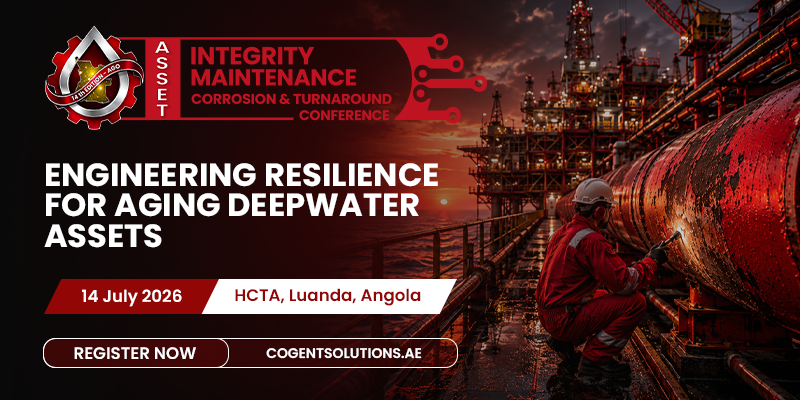
AIMCT Angola 2026 takes place on 14 July 2026 at the Hotel de Convenções de Talatona (HCTA), Luanda, Angola. Attendance is strictly by invitation only.
As an ACEN member, you hold a special invitation. To learn more about the event, visit:
👉 cogentsolutions.ae — AIMCT Angola 2026
To request your invitation details, contact us directly at info@acenergynetwork.org. The event is three weeks away — please reach out promptly to secure your place.
ACEN is the African & Caribbean Energy Network — a membership-based platform advancing sustainable energy, clean energy investment, and strategic partnerships across Africa and the Caribbean.