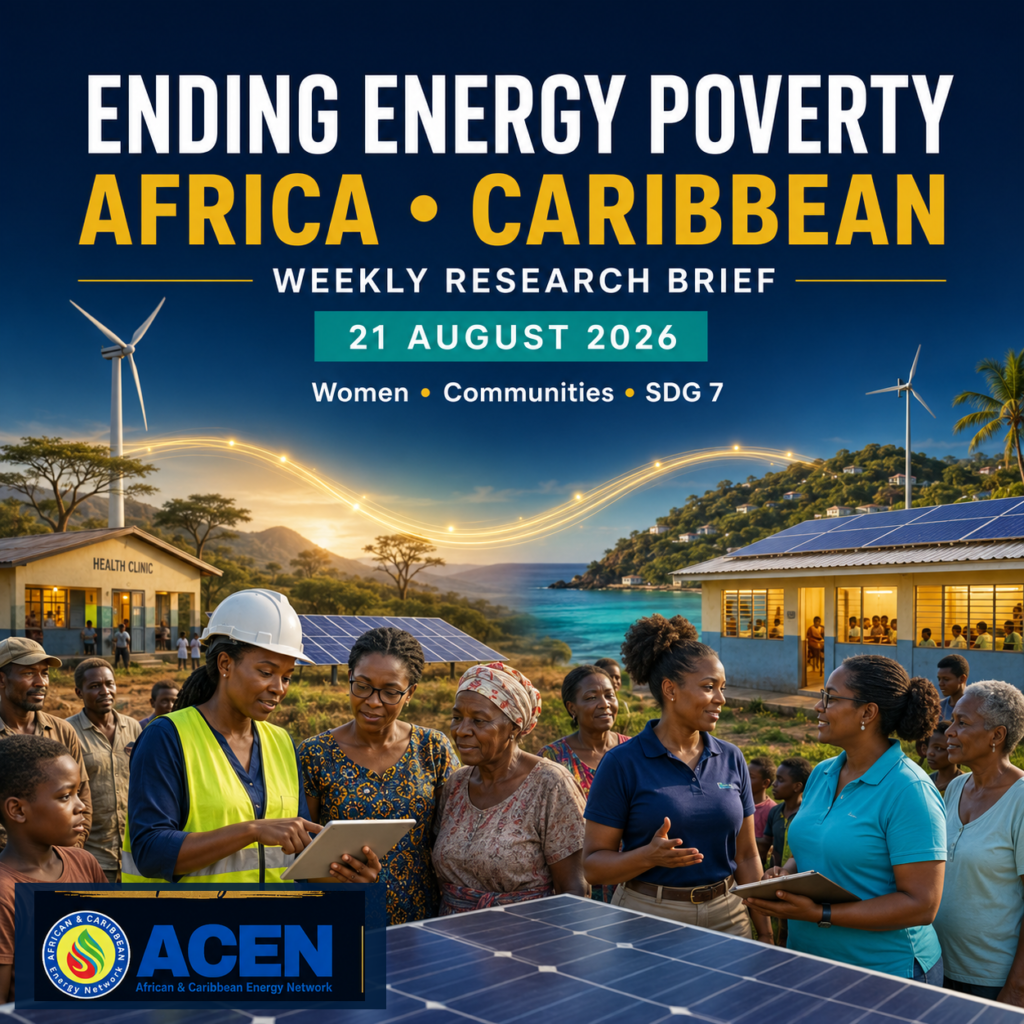
Energy poverty is not simply the absence of electricity. It affects whether a child can study after dark, whether a health clinic can preserve medicine, whether clean water can be pumped, and whether a woman can safely build and operate a business.
This week’s research confirms that although global energy access is improving, progress remains too slow and deeply unequal. Africa continues to carry the greatest electricity and clean-cooking deficits, while Caribbean communities face high electricity prices, unreliable service, dependence on imported fuels and vulnerability to economic and climate-related shocks.
The evidence also points toward a solution: energy initiatives are more effective and sustainable when women and communities participate in their design, ownership and governance.
The Global SDG 7 Warning
The Tracking SDG 7: Energy Progress Report 2026 estimates that approximately 655 million people still live without electricity, while around two billion people lack access to clean cooking.
Although 89 million people gained electricity access during 2024, population growth absorbed much of that progress. The global number of people without electricity fell by only about 11.5 million.
The remaining energy-access deficit is increasingly concentrated in Africa, rural communities and a relatively small group of countries.
Why This Matters for ACEN
These findings reinforce ACEN’s position that ending energy poverty must become a global development priority. Electricity is the foundation that enables countries to improve healthcare, education, water access, food security, digital participation and economic opportunity.
SDG 7 is not an isolated energy goal. It is the infrastructure that supports progress across nearly every other Sustainable Development Goal.
Read Tracking SDG 7: The Energy Progress Report 2026
The Road to 2030 Runs Through Africa
A recent Sustainable Energy for All analysis finds that most of the world’s remaining electricity-access deficit is concentrated in just 22 countries, with African countries carrying the greatest burden.
Africa has also overtaken Asia as the region with the world’s largest clean-cooking gap. Women and girls are disproportionately affected through household air pollution, unpaid labor, lost educational opportunities and reduced economic participation.
Why This Matters for ACEN
Global energy-access efforts must become more focused. Resources should be directed toward the countries, rural communities and vulnerable populations where the deficit is greatest.
Progress should not be measured only by the number of new electrical connections. Affordability, reliability, clean cooking, productive use and the electrification of schools and healthcare facilities must also be considered.
Understanding Energy Poverty in the Caribbean
The Inter-American Development Bank’s report, The Price of Power: How the Caribbean Can Build a More Secure Energy System, examines electricity capacity, consumption, costs and prices in The Bahamas, Barbados, Guyana, Jamaica, Suriname, and Trinidad and Tobago.
The report identifies common regional challenges, including exposure to volatile oil prices, expensive electricity, dependence on imported fuels and difficulties providing reliable service to remote communities.
Why This Matters for ACEN
Energy poverty presents differently across the two regions ACEN serves.
In many African communities, the primary challenge remains gaining an electricity connection. In the Caribbean, energy poverty may appear through unaffordable bills, unreliable service and energy systems that leave households and businesses exposed to external shocks.
Both situations restrict economic opportunity and community development. Regional cooperation, distributed renewable energy, modern electricity grids and stronger investment frameworks will be essential to building a more secure energy future.
From Community Consultation to Community Ownership
The Community-Centric Minigrid Toolkit, developed through the Africa Minigrids Program, offers a practical framework for involving communities throughout the lifecycle of renewable-energy projects.
The featured approaches move beyond limited consultation by involving communities in governance, financial decisions, ownership and accountability.
One Nigerian community holds a 20% equity stake in its minigrid, while a women and youth apprenticeship program in Botswana has strengthened local participation and community ownership.
Why This Matters for ACEN
Energy infrastructure is more likely to succeed when communities understand the project, trust its operators and have a meaningful role in its future.
Women must be included not only as beneficiaries but also as engineers, entrepreneurs, technicians, investors, policymakers and community decision-makers.
Community-centered energy development can provide local ownership opportunities, technical training, support for women-owned businesses and greater transparency around tariffs and revenue management.
Explore the Community-Centric Minigrid Toolkit
Energy Justice Must Include Women and Marginalized Communities
A new IDB systematic review, Mapping the Nexus Between Women, Ethnic Groups and Environmental Vulnerability, finds that climate and environmental disruption disproportionately affect women, Indigenous Peoples and Afro-descendant communities.
The research identifies women’s participation in decision-making as an important pathway to community resilience. It also warns that structural barriers continue to limit marginalized communities’ ability to recover from environmental and economic losses.
Why This Matters for ACEN
An energy transition cannot be considered inclusive if the communities most affected by poverty and climate vulnerability are excluded from planning, financing and ownership.
Clean technology alone does not guarantee energy justice. The way projects are designed, governed and financed matters.
Women and representatives of affected communities must have meaningful opportunities to participate in project planning, implementation, oversight and evaluation.
ACEN’S PERSPECTIVE
The message from this week’s research is unmistakable:
Ending energy poverty requires more than installing infrastructure. It requires affordable power, reliable service, women’s leadership, community ownership and investment that reaches the people carrying the heaviest burden.
Africa and the Caribbean face different energy realities, but both regions need solutions designed with communities—not simply delivered to them.
When women are included as leaders and communities are treated as partners, energy access becomes more than a connection. It becomes a pathway to education, healthcare, safety, entrepreneurship and lasting economic opportunity.
Join the Conversation
What would meaningful community ownership of energy projects look like in your country?
We invite policymakers, energy professionals, investors, community leaders, women’s organizations and development partners to join ACEN in advancing practical solutions for affordable, reliable and inclusive energy.
African & Caribbean Energy Network
Ending Energy Poverty. Advancing SDG 7.
acenergynetwork.org
Social media: @acenergynetwork