African & Caribbean Voices Put Climate Justice, Sovereignty and Delivery Centre Stage
Friday did not cool down! 🔥
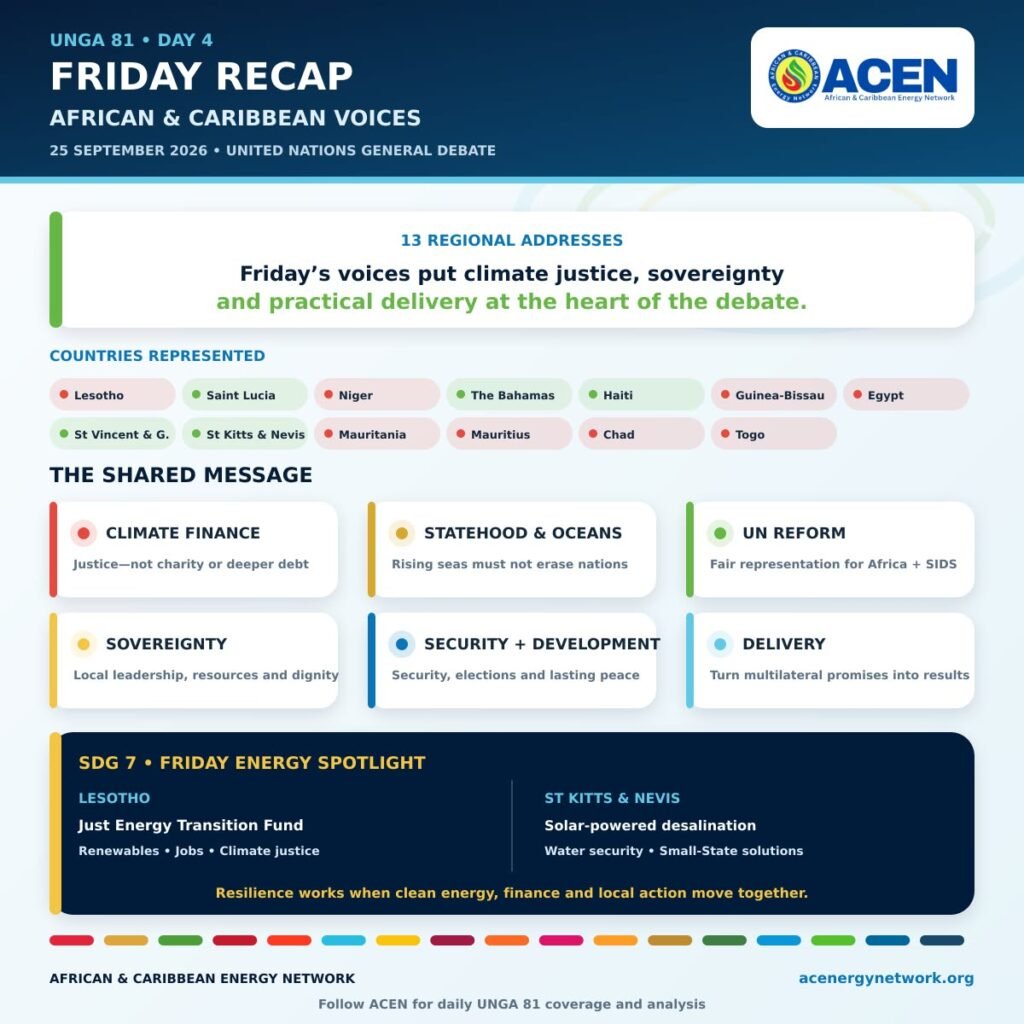
Thirteen African and Caribbean countries addressed the General Assembly, bringing powerful messages on climate justice, sovereignty, peace, development finance and reform of the international system.
🇱🇸 LESOTHO
Prime Minister Samuel Ntsokoane Matekane emphasized preventive diplomacy, strong institutions and fairer global representation. He warned that climate change is already causing floods, droughts and land degradation, while highlighting Lesotho’s Just Energy Transition Fund as a vehicle for renewable energy, jobs and economic opportunity.
🇱🇨 SAINT LUCIA
Prime Minister Philip J. Pierre declared that climate finance is not charity—it is about justice, responsibility and survival. He also called for support for Haiti, reparatory justice and greater representation for Africa, the Caribbean and other developing regions.
🇳🇪 NIGER
Prime Minister Lamine Zeine Ali Mahaman delivered a forceful defence of African sovereignty, resource ownership and the Alliance of Sahel States. He rejected portrayals of Africa as dependent on aid and argued that Africa’s natural resources must benefit African people.
🇧🇸 THE BAHAMAS
Prime Minister Philip Edward Davis said the rules-based international order remains a vital shield for small States. He warned that rising seas must never erase a country’s statehood, boundaries or UN membership, while supporting stronger representation for small island States.
🇭🇹 HAITI
Prime Minister Alix Didier Fils-Aimé said Haiti is determined to break the cycles of violence, political transition and dependency. He called for stronger security assistance, credible elections and a shift from traditional aid towards investment, jobs and genuine partnership.
🇬🇼 GUINEA-BISSAU
Prime Minister Ilídio Vieira Té reported progress towards restoring constitutional order and preparing elections. He also highlighted the damaging effects of poverty, inequality, debt and inadequate financing for development and climate action.
🇪🇬 EGYPT
Prime Minister Moustafa Kamal Madbouly focused on the Palestinian question, humanitarian access and implementation of the Gaza ceasefire. He also described Egypt’s water security and access to the Nile as existential issues that require cooperation rather than unilateral action.
🇻🇨 SAINT VINCENT AND THE GRENADINES
Prime Minister Godwin Friday warned that vulnerable countries cannot continue borrowing simply to replace what climate disasters repeatedly destroy. He called for climate vulnerability—not income alone—to determine access to affordable and concessional financing.
🇰🇳 SAINT KITTS AND NEVIS
Deputy Prime Minister Geoffrey Hanley presented practical examples of small-State climate leadership, including a solar-powered desalination plant that has significantly expanded reliable household water access. He stressed that rising seas must never erase sovereignty, nationality or maritime rights.
🇲🇷 MAURITANIA
Foreign Minister Mohamed Salem Merzoug called for a fairer United Nations, proper African representation on the Security Council and faster implementation of the Sustainable Development Goals. He also emphasized shared responsibility on migration and support for a just solution in Palestine.
🇲🇺 MAURITIUS
Foreign Minister Dhananjay Ramful placed oceans and water security at the centre of the climate discussion. He called for implementation of the High Seas Treaty and pointed to the Chagos Agreement as evidence that international law and multilateral institutions can help settle disputes peacefully.
🇹🇩 CHAD
Minister Abdelmadjid Abdelrahim Mahamat highlighted the enormous humanitarian pressure Chad faces while hosting more than two million forcibly displaced people. He reaffirmed Chad’s neutrality in Sudan’s conflict and condemned attacks affecting Chadian territory.
🇹🇬 TOGO
Foreign Minister Robert Dussey called for a pragmatic multilateralism that converts international commitments into results. He emphasized African-led mediation and celebrated the “Correct the Map” initiative as an important step towards recognition, representation and justice for Africa.
⚡ THE ACEN TAKEAWAY
Friday’s statements made one point unmistakably clear: climate action, energy security and development cannot be separated.
Lesotho’s Just Energy Transition Fund and Saint Kitts and Nevis’s solar-powered desalination project demonstrated what practical, locally driven solutions can achieve. But countries cannot deliver these solutions at the required scale while facing expensive finance, rising debt and repeated climate disasters.
Africa and the Caribbean are not asking for pity. They are demanding partnership, fair representation, accessible finance and the space to build resilient economies on their own terms.
The message from Friday was powerful: multilateralism must move beyond promises and start delivering measurable results for people.
Follow the African & Caribbean Energy Network as we continue tracking the voices, commitments, and energy priorities emerging from UNGA 81.