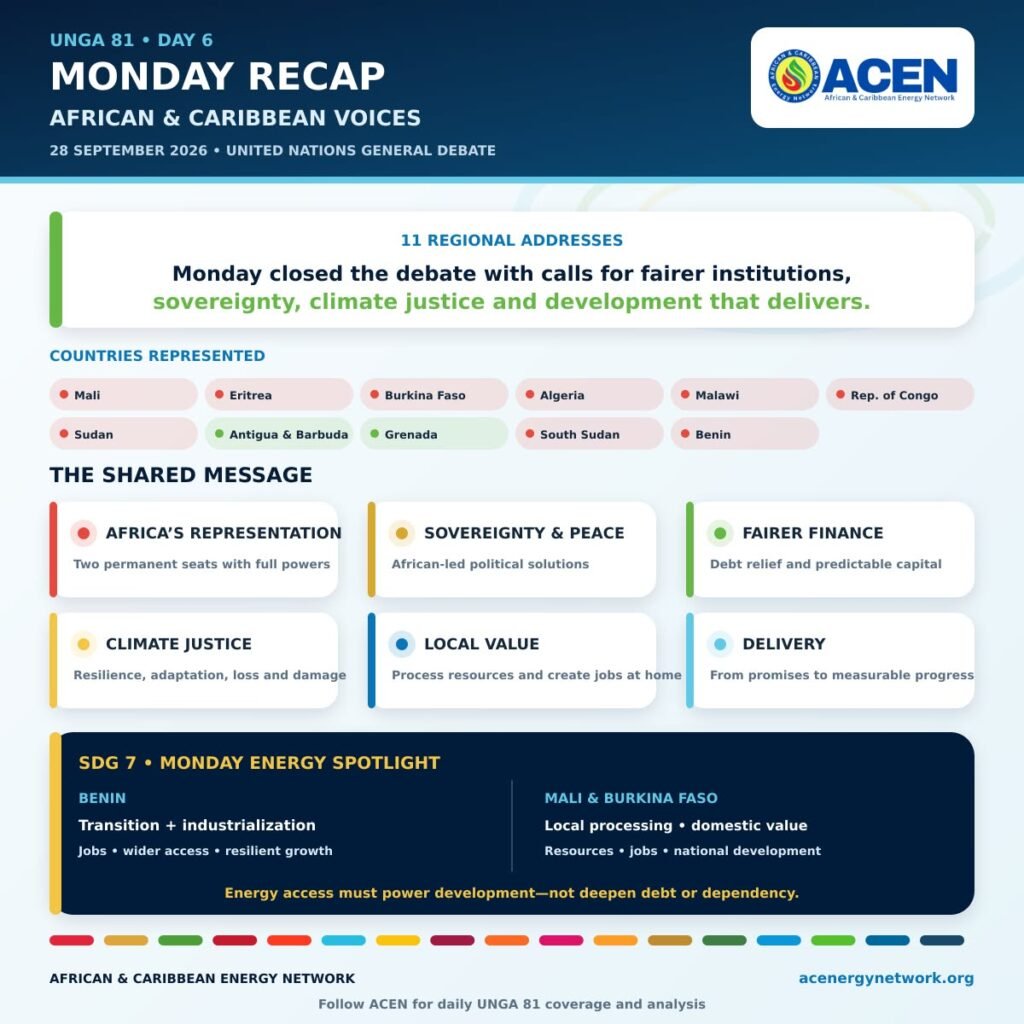
The final day of the UNGA 81 General Debate featured 11 African and Caribbean countries: Mali, Eritrea, Burkina Faso, Algeria, Malawi, the Republic of the Congo, Sudan, Antigua and Barbuda, Grenada, South Sudan and Benin.
Their addresses brought the debate back to several urgent priorities: sovereignty, peace, reform of international institutions, climate justice, fairer development finance and economic transformation that delivers tangible results for people.
🇲🇱 MALI
Foreign Minister Abdoulaye Diop defended Mali’s policy of “strategic autonomy” and rejected external dictates. He emphasized national control of resources, including gold and lithium, while warning that climate change and desertification threaten livelihoods, development and security across the Sahel.
🇪🇷 ERITREA
Foreign Minister Osman Saleh Mohammed called for a fairer international order founded on economic justice, mutual respect and a more equitable distribution of prosperity. Eritrea also urged stronger action on climate change and an end to destabilizing external intervention.
🇧🇫 BURKINA FASO
Speaking on behalf of the Confederation of Sahel States, Foreign Minister Karamoko Jean Marie Traoré rejected neocolonialism and called for African-led security solutions. He highlighted Burkina Faso’s efforts to process raw materials locally so that the country’s resources produce employment, revenue and opportunity for its people.
🇩🇿 ALGERIA
Minister Ahmed Attaf criticized the selective application of international law and called for profound reform of the UN Security Council. Algeria maintained that Africa must receive permanent representation with full decision-making powers—not symbolic participation.
🇲🇼 MALAWI
Foreign Minister George Chapatula Chaponda described economic transformation as an urgent survival strategy. Malawi called for comprehensive debt relief, investment in industrialization and regional value chains, accessible climate finance and effective implementation of the Loss and Damage Fund.
🇨🇬 REPUBLIC OF THE CONGO
Foreign Minister Constant Serge Bounda declared that Africa is not asking for a favour but claiming its rightful place in international decision-making. He called for Security Council reform, debt relief, economic diversification and fair compensation for the environmental and carbon services provided by the Congo Basin.
🇸🇩 SUDAN
Foreign Minister Mohieldin Salim Ahmed Ibrahim said Sudan seeks a just and sustainable peace free from external interference. He called for an end to the flow of weapons and mercenaries, accountability for attacks against civilians and an inclusive political transition leading to elections.
🇦🇬 ANTIGUA AND BARBUDA
Ambassador Walton Alfonso Webson warned that small States frequently pay the price for geopolitical, financial and trade disputes they did not create. He called for implementation of the Antigua and Barbuda Agenda for Small Island Developing States and wider use of the Multidimensional Vulnerability Index when determining access to finance.
🇬🇩 GRENADA
Ambassador Ingrid Jackson said the United Nations must deliver progress—not simply promises. Grenada called for investment before disasters strike, accessible and predictable climate finance, stronger support for Haiti and equitable access to emerging technologies.
🇸🇸 SOUTH SUDAN
Ambassador Cecilia Adout Majok Adeng highlighted South Sudan’s planned December 2026 elections, declaring that “the ballot must replace the bullet.” She stressed that peace cannot be sustained without development, infrastructure and investment in agriculture, water, education and healthcare.
🇧🇯 BENIN
Ambassador Marc Hermanne Araba called for stronger regional security cooperation, predictable development finance and urgent attention to climate adaptation and loss and damage.
Benin also delivered Monday’s clearest energy message: the energy transition must create opportunities for industrialization, employment and improved energy access.
⚡ ACEN’S SDG 7 PERSPECTIVE
Monday’s addresses demonstrated that energy access cannot be separated from peace, climate resilience, industrial development and economic sovereignty.
Mali and Burkina Faso emphasized local processing and national value creation. Malawi, the Republic of the Congo and the Caribbean representatives reinforced the need for accessible, concessional and predictable finance. South Sudan reminded the Assembly that development depends on practical infrastructure that reaches farmers, schools, hospitals and communities.
For the African & Caribbean Energy Network, the conclusion is clear:
Energy access must power development, not deepen debt, vulnerability or dependency.