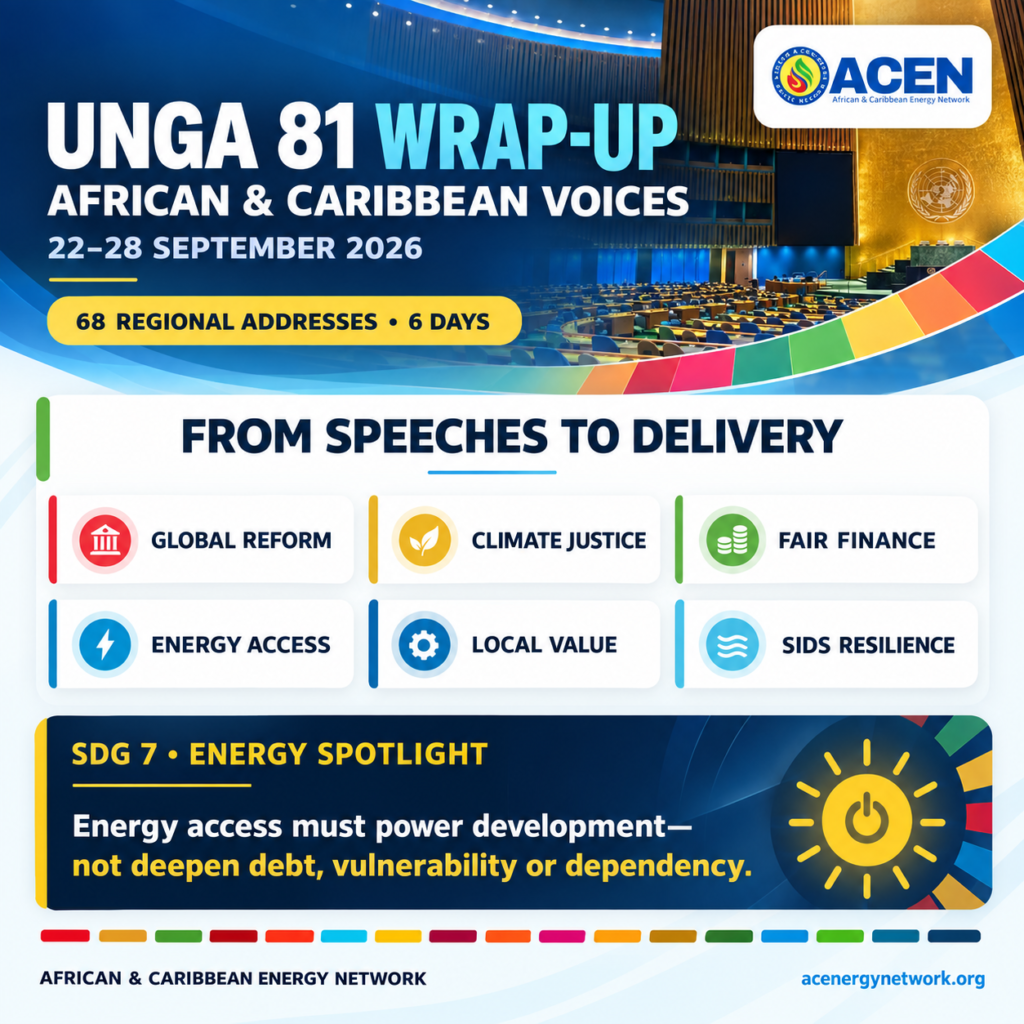
The General Debate of the 81st Session of the United Nations General Assembly concluded on Monday, 28 September 2026, following six days of national addresses.
Throughout the debate, the African & Caribbean Energy Network followed 68 speeches delivered by leaders, ministers and permanent representatives from African and Caribbean countries.
Although every country brought its own national priorities to the General Assembly Hall, a remarkably consistent message emerged: Africa and the Caribbean are not simply asking to participate in global decision-making. Our regions are presenting solutions, and demanding international systems capable of delivering fair, practical and measurable results.
From Security Council reform and debt relief to climate finance, energy access, peace, technology and local value creation, speakers repeatedly challenged the international community to move beyond promises.
Six Days of African and Caribbean Voices
Tuesday: Representation, resilience and energy security
The opening day featured Angola, Sierra Leone, Seychelles, Tanzania, Suriname, Dominica, and Trinidad and Tobago.
The day’s speeches emphasized a more representative multilateral system, respect for international law, affordable development finance, climate resilience and reliable energy.
Dominica’s renewable-energy ambitions and Tanzania’s focus on hydro, solar, wind, geothermal energy and clean cooking demonstrated how energy policy can connect climate action with national development.
The message was clear from the beginning: Africa, the Caribbean and Small Island Developing States are not only asking to be heard—they are presenting solutions.
Wednesday: Reform, resources and African-led development
Wednesday brought addresses from Burundi, Libya, the Dominican Republic, Botswana, the Central African Republic, Ethiopia, Namibia, Kenya, Mozambique, Guinea, Eswatini, Uganda, Rwanda and the Democratic Republic of the Congo.
Security Council reform, debt, climate resilience, sovereignty and responsible management of natural resources dominated the day.
Several countries argued that Africa must capture more value from its minerals and other natural resources through domestic processing, industrialization and stronger regional value chains.
Energy access was presented not simply as an electricity target, but as the foundation for education, healthcare, industry, employment and greater economic independence.
Thursday: Climate finance and value at the source
Zimbabwe, Madagascar, Ghana, Guyana, Somalia, Comoros, Liberia, Equatorial Guinea, The Gambia, Senegal, Côte d’Ivoire, Nigeria and Barbados spoke on Thursday.
Their interventions strengthened calls for predictable, affordable and non-debt-creating climate finance.
African countries emphasized the importance of processing critical minerals locally instead of continuing to export raw materials while importing finished products at a higher cost. Caribbean representatives reinforced the particular vulnerabilities of small States facing hurricanes, rising seas, debt and limited access to concessional finance.
The day’s central message was that a fair energy transition must create value, security and opportunity within the countries supplying the resources that make that transition possible.
Friday: Climate justice, sovereignty and survival
Friday’s speakers included Lesotho, Saint Lucia, Niger, The Bahamas, Haiti, Guinea-Bissau, Egypt, Saint Vincent and the Grenadines, Saint Kitts and Nevis, Mauritania, Mauritius, Chad and Togo.
Caribbean countries warned that rising seas are not only environmental threats. They endanger freshwater supplies, infrastructure, economies, communities and, ultimately, the continued existence of island nations.
African representatives connected security, sovereignty and sustainable development, arguing that lasting peace requires institutions, employment, infrastructure and credible national leadership.
Lesotho’s just-energy-transition ambitions and Saint Kitts and Nevis’s use of solar-powered desalination demonstrated how clean energy can support jobs, water security and climate resilience simultaneously.
Saturday: Technology, finance and opportunity
Belize, Cabo Verde, Cuba, Djibouti, Tunisia, Gabon, Jamaica, São Tomé and Príncipe, Zambia and Cameroon delivered Saturday’s African and Caribbean interventions.
Speakers called for accessible climate finance, fairer trade and investment systems, stronger educational opportunities and global technology rules that do not leave developing countries behind.
They warned that artificial intelligence and digital transformation must help close existing development gaps, not widen them.
Jamaica and Cabo Verde emphasized the climate and financial vulnerability of island States, while Zambia and Cameroon connected diversified energy systems, regional trade and African economic integration.
The message was that a just transition requires more than technology. It requires finance, skills, effective institutions and genuine international partnership.
Monday: From international promises to practical delivery
The final day featured Mali, Eritrea, Burkina Faso, Algeria, Malawi, the Republic of the Congo, Sudan, Antigua and Barbuda, Grenada, South Sudan and Benin.
Calls for African representation, economic sovereignty, peace, debt relief and climate justice remained strong throughout the closing session.
Mali and Burkina Faso emphasized strategic autonomy, national ownership of resources and local processing. Malawi called for debt relief, industrial investment and accessible climate finance. The Republic of the Congo demanded fair compensation for the environmental services provided by the Congo Basin.
Antigua and Barbuda and Grenada called for international systems that properly recognize the structural vulnerability of Small Island Developing States.
Benin delivered one of the week’s clearest energy messages: the transition must create space for industrialization, employment and improved energy access.
The Shared Messages from Africa and the Caribbean
1. Global institutions must reflect today’s world
Calls for UN and Security Council reform were among the most consistent messages of the week.
African representatives argued that a continent of more than 1.5 billion people cannot remain without permanent representation on the Security Council. Caribbean and other small States similarly called for international decision-making that respects countries regardless of their population, wealth or military power.
Representation must extend beyond visibility. It must include meaningful decision-making authority.
2. Climate finance must not create another debt crisis
African and Caribbean countries contribute comparatively little to global emissions, yet many face the most severe consequences of climate change.
Speakers repeatedly called for climate finance that is accessible, predictable and affordable. Vulnerable countries should not be forced to borrow at high interest rates to rebuild infrastructure damaged by disasters they did little to cause.
Climate finance must support adaptation, resilient infrastructure, renewable energy and loss-and-damage responses without deepening national debt.
3. Energy access is essential development infrastructure
Across the six days, energy emerged as a connecting thread between nearly every major issue discussed.
Reliable and affordable energy supports hospitals, schools, agriculture, water systems, digital connectivity, local businesses and industrial development. Without energy access, progress across the Sustainable Development Goals becomes slower, more expensive and less equitable.
SDG 7 is therefore not an isolated objective. It is an enabling foundation for sustainable development.
4. Natural resources must create value at home
Several African countries challenged the long-standing model in which the continent exports raw materials but captures only a small share of the resulting economic value.
The global energy transition is increasing demand for critical minerals and other resources found across Africa. However, the transition cannot be considered just if producing countries remain without sufficient electricity, industries, skilled employment and domestic processing capacity.
Resource-rich countries must be supported in building regional value chains, manufacturing industries and infrastructure that benefit their people.
5. Small Island Developing States require solutions designed for their realities
Caribbean and African island States reminded the Assembly that vulnerability cannot be measured by income statistics alone.
A hurricane can destroy decades of development in a matter of hours. Rising seas threaten coastlines, communities and freshwater supplies. High borrowing costs make recovery even more difficult.
The Multidimensional Vulnerability Index, disaster-preparedness investment, resilient energy systems and accessible concessional finance must become central to the international response.
6. Peace and development cannot be separated
Speakers from conflict-affected and fragile States stressed that peace cannot be sustained through security measures alone.
People require functioning institutions, education, healthcare, infrastructure, employment and confidence in their country’s future. Similarly, development projects cannot succeed where conflict, political instability and insecurity remain unresolved.
Peace and sustainable development must advance together.
7. Technology must narrow—not widen—the development divide
Artificial intelligence and digital transformation received significant attention throughout the debate.
African and Caribbean countries supported innovation but warned that unequal access to technology, infrastructure, data and skills could deepen existing inequalities.
The Global South must participate in designing international technology rules and benefit meaningfully from the digital economy.
ACEN’s SDG 7 Perspective
For the African & Caribbean Energy Network, UNGA 81 reinforced a fundamental truth: ending energy poverty is essential to achieving sustainable development.
A just energy transition must:
- Expand affordable and reliable electricity access.
- Accelerate clean cooking solutions.
- Strengthen climate-resilient energy infrastructure.
- Support local manufacturing and mineral processing.
- Create employment and opportunities for young people.
- Give women a meaningful role in energy leadership.
- Provide affordable finance without increasing debt distress.
- Respect national priorities while strengthening regional cooperation.
- Deliver practical benefits to communities—not simply international targets.
Energy access must reach the farmer seeking a dependable route to market, the student trying to study after sunset, the health centre protecting lifesaving medicines, the entrepreneur building a local business and the family that should not have to choose between fuel, food and other basic needs.
From Speeches to Delivery
UNGA 81 gave African and Caribbean countries an important platform, but speeches alone will not transform communities.
The real test begins after delegates leave the General Assembly Hall.
Will climate-finance commitments become accessible funding? Will Security Council reform move beyond another cycle of discussion? Will African minerals create industries and employment within Africa? Will vulnerable island States receive support before disasters strike? Will the energy transition reach the millions of people who still live without reliable electricity and clean cooking?
The African & Caribbean Energy Network will continue advocating for solutions that connect energy access with education, healthcare, climate resilience, economic opportunity and human dignity.
Our regions have spoken clearly.
Now the international community must move from promises to implementation—and from implementation to measurable results.
Energy access must power development, not deepen debt, vulnerability or dependency.
African & Caribbean Energy Network
acenergynetwork.org
#UNGA81 #SDG7 #EnergyAccess #Africa #Caribbean #ClimateJustice #EnergyTransition #SustainableDevelopment #SIDS #AfricanDevelopment #ACEN